


Activist speaks to CAGE about Austrian anti-terror raid after viral video exposes Zionist ambassador
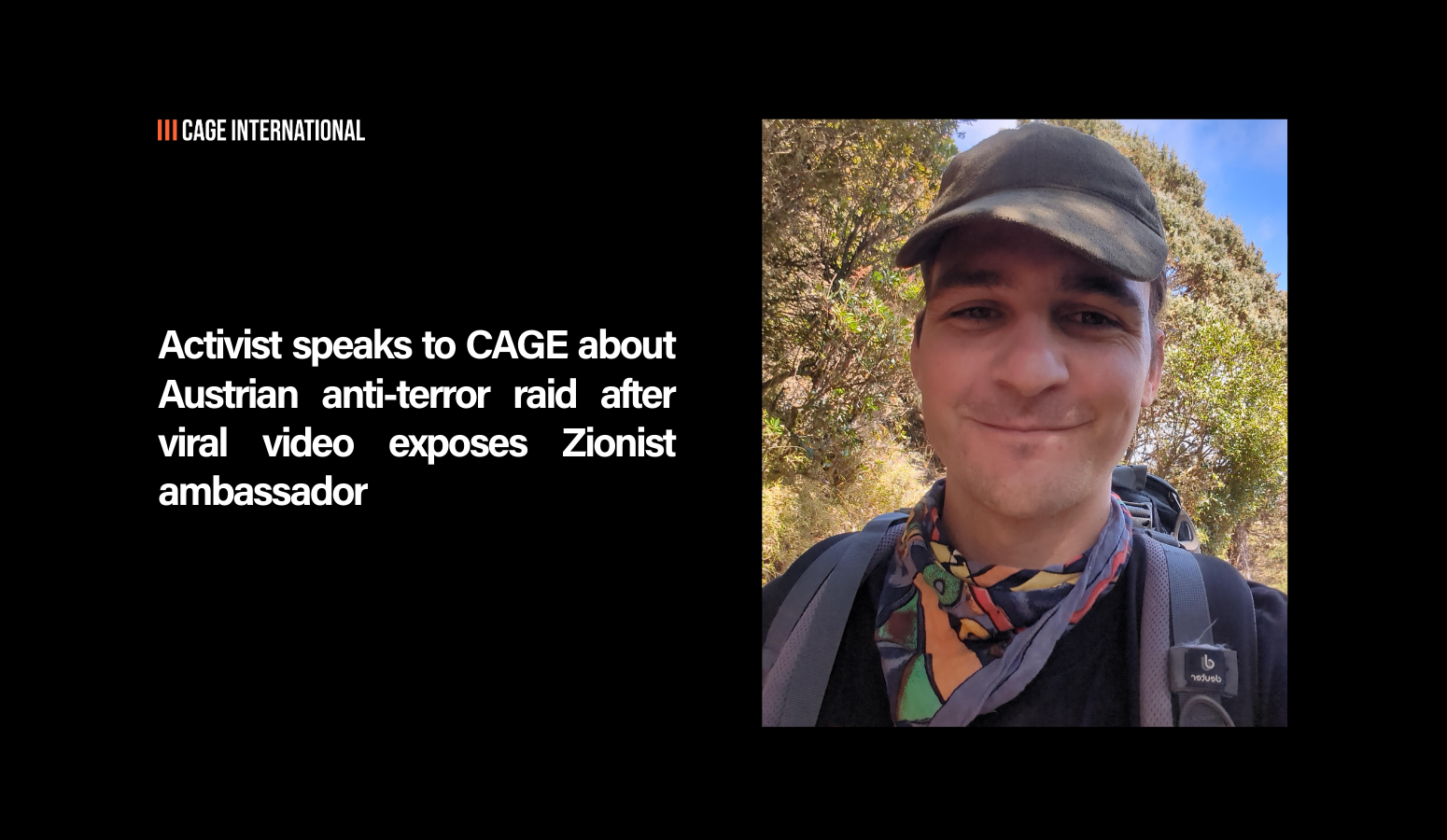

CAGE International interviewed Albert Serfaty (28) who was raided in 2025 by Austrian counter-terror police after a video of the Israeli Ambassador to Austria was leaked. Addressing a meeting of Jewish community members, ambassador David Roet suggested that Palestinian minors should be executed for “holding a gun” or a “grenade”, without providing any evidence of children carrying weapons.
Serfaty is of Jewish origin. A German citizen residing in Austria, he lost his job as a result of the raid. Though a qualified biotechnologist in the agricultural field, Serfaty dedicates his time to being an activist. This is his story.
1 - Tell us about your activist background.
It was through my sister, who was doing humanitarian work in the DRC, that I became more interested in humanitarian work outside of the climate space. She invited me to the No Borders Climate Camp in Switzerland where the issue of migration was presented, and neo-colonialism and extractivism.
It was at that camp about 2 years ago where I made the connection that this is not just about the question of lifestyle or information, but that there are systems in place, there are people in place that make sure the system stays the way it is and that was really a politicising moment.
2 - You attended a meeting in 2025 being addressed by the Israeli Ambassador to Austria. Why were you invited to attend?
When I arrived in Innsbruck, where I did my studies, I was interested in connecting with the Jewish community. That was also before I was politicised. The only community that existed was this centre in Austria for Jewish people. I joined for some High Holidays. However, since 7 October (2023), it became unbearable, because you realised how much people were apologetic of what was happening, and were siding with genocide.
So my joining of events organised by this community, became more a question of politics. I wanted to understand how these events were trying to shift the discourse. I was added to a newsletter where anytime an event was happening, it was shared with me. One of these events in March (2025) was the visit of the Israeli Ambassador to Austria, David Roet.
3 - What was going through your mind while the ambassador was speaking?
He was speaking for about an hour uninterrupted with a few questions (about) his role as an ambassador.
And then he started to talk about things related to Gaza. And that's when I realised, “Oh wow, this is insane!” The things that he was saying kind of made ‘sense’ in the space that he was saying them, because it was like, a high official representing the government, and so you would expect something like that to be said.
But when you realise what he is actually saying (about Palestinians), that this is a human, with emotions, that this is somebody who grows up loving other humans and who has a soul, has a heart, has empathy - you realise the things he is saying are completely dystopic and cruel.
So that was incredible to hear those words being said, with everyone just nodding and watching and saying nothing as it was a person of power.
4 - The video of the ambassador goes viral and subsequently you face a raid by the Austrian police. Walk us through what happened.
There was a statement by the community taking away any blame on their side, putting themselves as the victim. I thought at that stage, “Okay, maybe this is it.”
A month later, I get a I get a phone call. I was out of the country, and it was saying, "Hey, this is the special anti-terror police. We are at your door. If you are around, you are free to join us so that you can watch us basically raiding your house as a witness, and otherwise, we're still going to go ahead with it." And they said that, "Yeah, this is relating to a video. We think you know what we're talking about anyways, and you have no choice, we're going to go through with this anyways.”
This was an extremely scary moment. They went inside, where my room was and started to go through everything and take anything that they thought was of interest. So, anything that had data on it, including notebooks, an old phone, my work computer and hard drive. They even took my iPod Nano with all my 2006 greatest hits!
They took pictures of everything and then left, called me and were like, "Yeah, this has gone through now. We have all of your things. If you want them back, you need to go to the police station by yourself and sign a sheet that confirms that this was at your house, and that we now have your things."
5 - Has your perception of counter-terrorism police shifted in any way ie prior and post the raid?
Prior to that point, maybe before (my) politicisation, I thought maybe this is a good thing. I was still thinking, “Hey, at least we need police that counter terrorism, right? That is always going to be a good thing because terrorism is bad.” In the last year or two, I've seen this take a whole other shape, where especially on the left, on activists, on organisations that are against the state - that are against repression and the capitalist ruling class - there is this incessant need to paint them as terror organisations.
Never would I have thought that they would go so easily into someone's house, related to something that is in reality not a serious offense. So that definitely changed my understanding of the power they have, but also how quickly that can change - how quickly, to my understanding, justice or the legislative process that needs to follow a lot of rules in order to get the right to do something like that, can be co-opted or can be overturned when there is an external or political interest involved.
6 - Do you see your case fitting into broader repression of pro-Palestine activism in Austria and Germany?
There is a definitely mounting repression on a number of fronts, whether that is direct repression on the streets that we're seeing with activists in Berlin and also in Vienna, as well as academic repression.
I think in a German speaking context, ie in Austria and Germany, there is definitely this ‘need’ to repress any kind of voice that might show criticism of the state of Israel, that might show solidarity with Palestine, because of this historical guilt (following the second world war).
Especially in Austria, there is a cultural connection where Austrians feel somehow obliged to support Zionism. Because of that, there is no acceptance of this discourse appearing in the public and that was seen through the lack of media coverage over the story (of the ambassador’s statements), but perhaps also over the severity with which this case was handled - on one hand saying we need to do everything to protect the Jewish community that is ‘a victim’ of this action, and on the other hand, we need to go as far as possible to stop anyone trying to show us in a bad light, or show us publicly somehow accepting solidarity with Palestine.
7 - Subsequent to the raid, what has been the material impact on you?
There was mainly the fact that I had lost my work computer, which I had to repay and then because of that, I lost my job - because my work was not able to wait for me to get a new computer and was quite annoyed that I couldn't work for a few days because of it. Losing a job is always going to put you in a precarious situation.
In terms of the things that had been taken away from me, there were also some complications. Like my Notebook with all my personal details - it took an incredible amount of time to restore all of that information. The phone that they had taken was broken when they had given it back, so I had to fix that one.
8 - Have you found work subsequently?
Yeah, so the action made me focus a lot more on activism - so trying to spend as much time as possible in work that is basically not paid, as most of the grassroots groups I'm at are volunteer-based. I have been able to find part-time work, working in the local university, where I'm able to sustain my living expenses.
Through the solidarity community that I was part of, I was able to deal with the effects of not having a job, (through) sharing housing and food.
9 - When the raid took place you were out of the country - did you go back into Austria and then did you leave again?
I had to go back to make sure I could get my things again. The following day, I went to the police station. I stayed for a few months, not having a fixed place as I was always under this fear that this might happen again. It was a rough couple of months and in September, I left.
Just to add, in June/July 2025, they called me in to the police station for questioning. This was the anti-terror unit and it was something that I had to go to. I didn't have a choice. I went there with a lawyer. They were going to question me. I knew I wasn't going to say anything, so, it was quite a short meeting. As soon as I entered, they asked me for my phone (which I did not have on me). It was clear that they were still after devices. They also asked me if I wanted to give them the pass key to my computer and to my other devices.
10 - What have been the legal consequences?
Charges were pressed by the state attorney. The state attorney asked to review my case personally, which I heard from my lawyer was quite unusual.
The state attorney approved the charges and the first court case was called in November 2025. I couldn't attend as I was out of the country.
Since then, my case has been pushed together with other cases of Palestine solidarity in Austria. There will be a court case probably in the spring where all of these cases will be handled together - maybe not all on one day, but there will be different court hearings following each other all within this one collective case.
11 - What has been the psychological and emotional burden of the raid?
I think maybe three levels: first there's the direct feeling of the attempt of your safe space being broken. The best way to deal with it was having the solidarity network of people who had already experienced this.
The second part was my immediate surrounding of family and friends. Family especially were furious about this happening: on one hand angry at the state, the fact that this can just happen; but also angry at me that I'm allowing these kinds of things to happen, that I'm getting involved in these kinds of issues. I was asked not to go to my home anymore. That was really uprooting.
The last part that psychologically was a bit difficult, is following up on this, especially relating to media. When some journalists started to report on it, that was a very scary moment. I was thinking, "Oh God, this might impact my case. I don't want all of these personal details to be shared for everyone to know that this happened to me."
On the other hand, experienced activists were telling me, this is a moment to share your story, to own up to it that this happened to you specifically and give this another light. Also, it feels strange to be personally in the spotlight for an action as opposed to acting as a collective.
12 - Coming to the supportive community, what has been the impact of those relationships?
I'm very lucky to have this kind of community in Austria; of activists, but also international people, who look out for each other. We are always organising in solidarity, whether it's a movie night, a festivity, or just a political discussion or demonstration.
So having this community that is more than just centered on activism makes a huge impact because you know that there's going to be a lot of people who you can learn from, rely on and trust.
Through that, I met a lot of other communities eg. an anti-Zionist Jewish community with which we organised the first Anti-Zionist Jewish Congress in Vienna that was very successful. Through that organisation, I was able to find a community related to my Jewish ancestry, where I knew that we had the same views and it was okay to speak about it.
13 - What was the feedback of the other community at the centre in Innsbruck that you had initially gone to?
It's mixed, really. Some people saw me on the street and they just shook their heads and said things like: "Remember you are still Jewish and if you ever go to Palestine this and this would happen."
Then also people my age who were apolitical and who just took the same narrative as the community, putting themselves as the victim and saying, "Oh look, but all of these people are now at risk," as opposed to analysing what was actually said (by the ambassador) and realising the effect on Jewish people. If somebody can speak like that openly, which happens every day, what does that do for Jewish communities?
14 - Tell us more about the collective that has been supportive of you.
Since it's not a big city, the political community is quite small. Then if you look at the pro-Palestine community, it's even smaller. So that leaves a group of people who look out for each other, who are in solidarity, but who are also in a lot of different groups.
The main groups that were supportive were the Anti-Repression Group - so facing anything related to legal fees or police violence. That was a rock in a situation that was very unstable.
And the Palestine Initiative Tyrol, who are doing incredible work with Palestinian activists, with activists of Jewish background. It was a dream to have a community like that after facing this kind of oppression.
15 - Tell us about some of the other cases in Austria where others have faced similar consequences?
These are mainly are cases of police raids that have happened in a number of places, not directly related to Palestine, but related to activism on the left.
There have been a number of raids. One happened in Innsbruck in September where it was a lot more brutal. They also went to a cafe that was known for hosting events and that was incredibly severe.
There have been raids in Graz very recently against anti-fascist activists. And in Vienna, also a number - I believe one was related to Palestine activism. So that is sadly becoming a common thing in Austria (with) activists on the left who are not involved in any violent activism.
16 - Would these raids be under anti-terror legislation as well?
Yeah. So, they use the same protocol most of the time. It's like the formation of an ‘extremist organisation’. The unit that then undertakes these kinds of operations is always the unit for extremism and terror prevention.
17 - Though your case is primarily linked to privacy related legislation, counter-terror police would have conducted the raid?
Right. During the questioning that I had in July 2025, they said that this was a very normal thing because a high politician was involved.
18 - The video went viral and attracted limited media coverage. Why? What has it been like interacting with the media?
It has been frustrating in Austria to speak with journalists, because they try to somehow push it in a way that they seem not to be supporting Palestine or, to seem like this is somehow an extremist action or taken out of context.
It was really frustrating to see journalists from respected papers, basically either not responding at all or trying to twist the story so that it fits their narrative. Because it would take a lot more to publish something that is critical of Zionism.
I think also, to be fair, because of the nature of the video happening in a private space, journalists probably were aware of this maybe being a delicate thing, as opposed to somebody speaking in public. Of course, at some point when it goes viral, I guess there's no more hiding it and you can use material that's so widely available.
19 - Did any politician reach out to you?
A local party met with me - all three founding members. I thought, "Oh, hey, maybe they want to do a press conference or they want to support." But basically, they just felt bad. They said, "We saw this when it came out and we don't agree with this, but now it's too late anyway, and we just want to make sure you're fine. Do you need money?" Like actually trying to hand me money! It was very messy.
I don't know what exactly they were trying to do - trying to put themselves as the ‘party of the young people’, but then not really having the guts to say anything; and one of the founding members even admitting to being more on the pro-Zionist side, but still wanting to meet because this is (something) horrible that happened.
20 - You had spoken about your politicisation, would you change that? Would you prefer to remain ‘ignorant’, just living life, or would you still embark on this path?
If you asked me a year ago, I would have probably been quite happy with the activism that I'm doing.
Right now, seeing the dystopia that we're living through, it takes a lot of responsibility to be in a case where you feel like you can change things surrounding you, and you also have the responsibility to change things, because you're one of the few people actually getting active, getting organised about it. It takes a toll.
So there are moments when I wish that maybe - not that I was out of it and the things were still going on - but that just the world was a bit less shit, and I could focus on actual interests related to my studies or to my love for nature, for the environment.
But it would feel strange not to not to get active with all of these things happening. To somehow be ignorant or to tell myself that that's just the way it is, it wouldn't feel right. It's a bug that bites you and you can't really go back.
21 - Is there anything you would wish to share with other activists on how they can protect themselves?
The obvious one which is most scary is the raid. So just being prepared for that eventuality, even if you don't think that that could happen. Not to discourage people to get active politically, please do, but be prepared for that kind of eventuality.
Start thinking also about digital security.
Day-to-day, even on the streets, there are some material things, like knowing the legislation governing a certain place or country, and what are your rights. Know who to call in, in case of repression.
Other than that, make sure you have a community of people who have been doing this kind of work for a while who you can ask for advice, who you can organise together and learn from.
Be in solidarity with people facing repression, because sometimes it's only a matter of time until you might be facing these kinds of things too.
22 - How would you like people to support you?
It's about a genocide that is still going on. The main focus is on making sure we are there for the people in Gaza. Whether that is a donation; sharing it on your accounts; speaking out in public to your politicians; putting pressure on companies who are still supporting the Zionist military and oppression, the apartheid regime; whether that is in the West Bank or in Gaza.
Outside of that, there is a community of activists in the imperial core, whether that's in Europe or the US, who are fighting against all of these interests that are still supporting, and without which, the Zionist entity could not function.
Support them (the activists) in any way you can. There is one group called the European Legal Support Centre, that deals especially with Palestine solidarity cases - they do incredible work.
Keep standing in solidarity with people in Gaza, as well as Sudan and Congo, where people are suffering from - whether it's extractivism or neo-colonial exploitation. Get informed, get organised.
23 - Being of Jewish heritage, are the consequences of your Palestine solidarity activism perhaps more severe?
It's important to remember that on a human basis, we are all the same. To say, like me, as a Jewish person, I'm doing this - of course, it can add some weight to actions. But in the end, the cause is against oppression which is mainly coming from a capitalist elite that have an interest in resources, in land, and controlling state, controlling borders - we are all fighting against this.
I think the role of Jewish activists is to show that the issue is not about anti-Semitism, but it's about fighting Zionism, which from my perspective, has anti-Semitic roots. If you look at the people who were supporting Zionism from the start, there were some very far-right German people who saw it as a solution, to the ‘Jewish problem’ in Europe.
So also to remember that our community is wherever we are: there is not one land, and you have no right to tell us where we should go, where we should live. We live all over the world. Whether you are practicing your religion or whether you are just following it or that is your background, just know that, there are people who try to speak for you, who try to say they are doing things in protection of you; it's your responsibility to say, “This is not happening in my name and my home is right where I am.”
24 - What is your message to the Palestinian people?
I can't explain the admiration I have for the resistance of the Palestinian people, their resilience. Through everything you have gone through, all the attempts to crush your spirit, to crush your community, you have kept your community, you have kept your belief, you have kept your solidarity among each other.
And everything we do here, whether it's in Europe or the US, it's to try to stop the oppression, the violence against you. We learn from you. We want to include Palestinian voices in our struggle because you have gone through the systems we are fighting, for so much longer.
We hope that you won't have to fight and you can start to rebuild and to live in peace.
25 - Is there anything else that you want to include in this interview?
CAGE does a lot of work related to activists in the UK, especially right now, related to the Filton activists. We know that a lot of things being decided in the UK in terms of repression against Palestine activism will follow in other countries.
Somehow (in Austria), there is less of these highly military partnerships, but it's a lot about fighting against this idea that Austria is a stronghold of supporting Zionism, because that's where the original Zionists came from.
So we're all trying to fight this on all fronts, but also, to motivate people to follow in the footsteps of activists in the UK and to take action not just in a cultural or public space, but actually against the military apparatus - whether that's production, shipment, or logistics - because these things work. We've seen how Allianz and other insurers have stopped insuring Elbit. These successes are directly related to direct actions taken.
26 - Can you tell us how your support network works?
The Anti-Repression Group Innsbruck provides legal support for cases related to political activism or state repression more broadly.
There is counseling that you can access to understand what are your rights – you will get tailored support.
In planning an action there could be support to help you understand what actions you want to do, what legal risk you are taking and making sure everything is prepared.
During the action itself, they are on call, so actually having that one phone call, instead of having a lawyer, which is very expensive. They organise arrestee support. They also deal with legal repression eg interpreting mail for people who don’t speak the language, and preparing contact with the lawyer.
And of course, also dealing with legal fees eg organising a fundraiser.
Also, contacting the media, to basically turn the story on the side of the activist to show, “Look, this is what the repression was.”
It makes a big difference when going into an action when you know these kinds of groups are there to support you.
Download Files


