


‘Habibi’ could not have operated for 18 years without institutional enablers
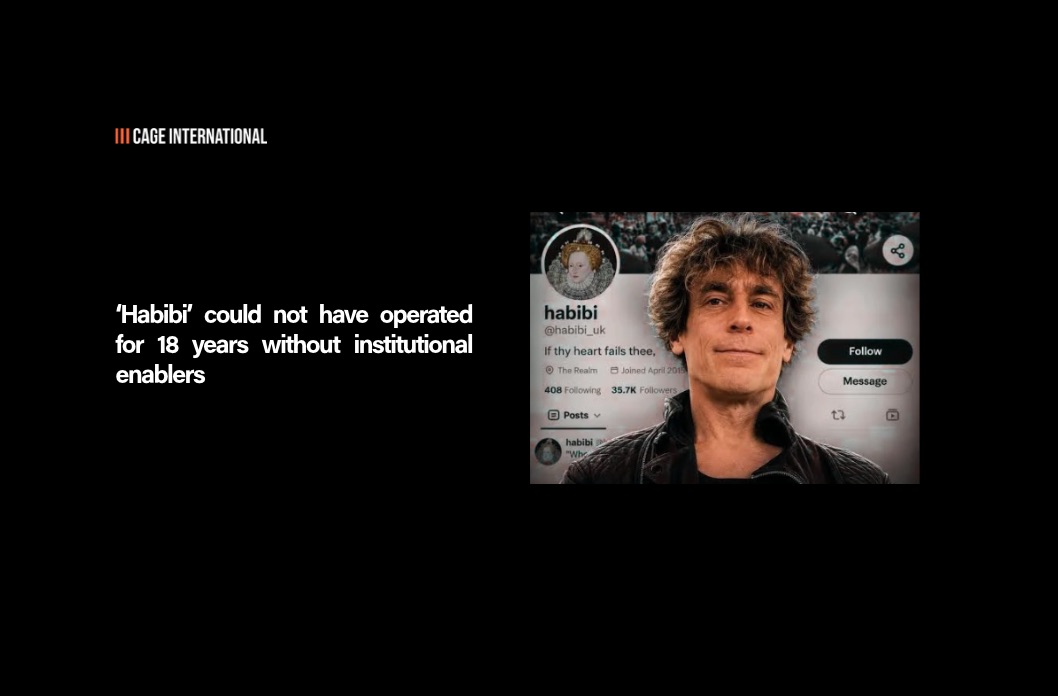

London — One of the most persistent voices involved in smearing Muslims and Islamic institutions in Britain has been identified by Byline Times as Benjamin Tait, the operator of the anonymous account @habibi_uk. The investigation’s data show that the account’s most persistent targets were Muslims and those organising for Palestine, among them CAGE’s Moazzam Begg and Asim Qureshi. Think tanks, newspapers and people in public office cited and amplified the account for years, and its claims about extremism followed Muslim institutions into regulators’ inquiries.
It is impossible to imagine that an account directing this kind of hostility at Jewish institutions could have operated anonymously for 18 years while being cited by think tanks, credited by national newspapers and amplified by people in public office. That Habibi did so is a measure of how deeply Islamophobia is embedded in British public life.
His work began with attacking Muslims. Early posts on the blog Harry’s Place carried titles such as “Ismail Patel: Extremist” and “Interpal and the Convoy”, and what started as the targeting of Muslim community leaders and charities widened over the years into a campaign against anyone who opposed Israel’s genocide in Gaza. Muslims never left the centre of it. Ismail Patel, the founder of Friends of Al-Aqsa, is still among the people the account has named most often, in 115 posts, and the Leicester activist Majid Freeman appears in 87. Over nearly two decades, Habibi helped build an infrastructure for smearing and disrupting the lives of individuals: a vocabulary of “extremism”, a body of posts others could cite, a network to amplify them, and institutions willing to treat them as evidence.
Byline Times mapped 57 accounts and more than 25,000 reposts and quote posts among them. The account’s largest named amplifier was David Toube, general counsel of the Jewish Leadership Council and a former policy director at Quilliam, who boosted it 694 times and alongside whom Habibi wrote on Harry’s Place from 2008. The Henry Jackson Society cited the account in two reports and thanked it for “expert feedback and review”. Lord Walney, the Government’s Independent Adviser on Political Violence and Disruption, shared its posts, and the account praised his review in return. Lord Austin, who discussed Tait by name in 2023, was appointed to lead a review of the 2022 Leicester unrest, the same subject on which the Henry Jackson Society had relied on Habibi. His findings were submitted in July 2025 and have still not been published. The public is entitled to know whether that review drew on Habibi’s material.
The network raises a more basic question about where Habibi was getting his information on Muslim individuals and organisations, and who was supplying it. It raises another about who knew his identity, and for how long. A High Court order compelled Twitter to disclose the account’s details in 2021, yet his name stayed hidden from the people he targeted for a further five years. Throughout that time he was able to target Muslim civil society unchecked, and it was only when the network turned on more mainstream liberal figures that his conduct came to be treated as a story.
Britain’s foreign interference laws are applied with vigour to Muslims and to those standing in solidarity with Palestine. The same scrutiny has not been turned on activity that consistently served the interests of a foreign state committing a genocide, and no one in authority appears to have asked whether any of it was funded, directed or supplied from abroad. Nor can the wider consequences be set aside. The environment Habibi and those around him built made opposition to Israel’s conduct appear suspect and those who voiced it appear dangerous. It is fair to ask whether the British state would have felt able to support a genocide broadcast live to the world had that environment not been built first.
The Byline Times investigation is valuable, and its data confirm much of what Muslim organisations have said for years. Yet it has so far led with celebrities. It contains no assessment of what this campaign has meant for Muslims, and it says nothing about the politically active Muslims who were the account’s most consistent targets. That story remains to be told.
Anas Mustapha, Head of Public Advocacy at CAGE, said:
“One of the most persistent voices targeting Muslims for nearly two decades was a man hiding behind a pseudonym, and our institutions treated him as an expert. Naming him does not undo the damage done to people’s reputations and livelihoods. The Henry Jackson Society, the newspapers that ran his material and the regulators who acted on it must bear full responsibility for fuelling and enabling this individual’s countless witch hunts. CAGE will explore all legal options to hold them to account.”
Download Files


