


Pakistan's "Counter-Terrorism” architecture and the proscription of Joint Awami Action Committee in Azad Jammu Kashmir
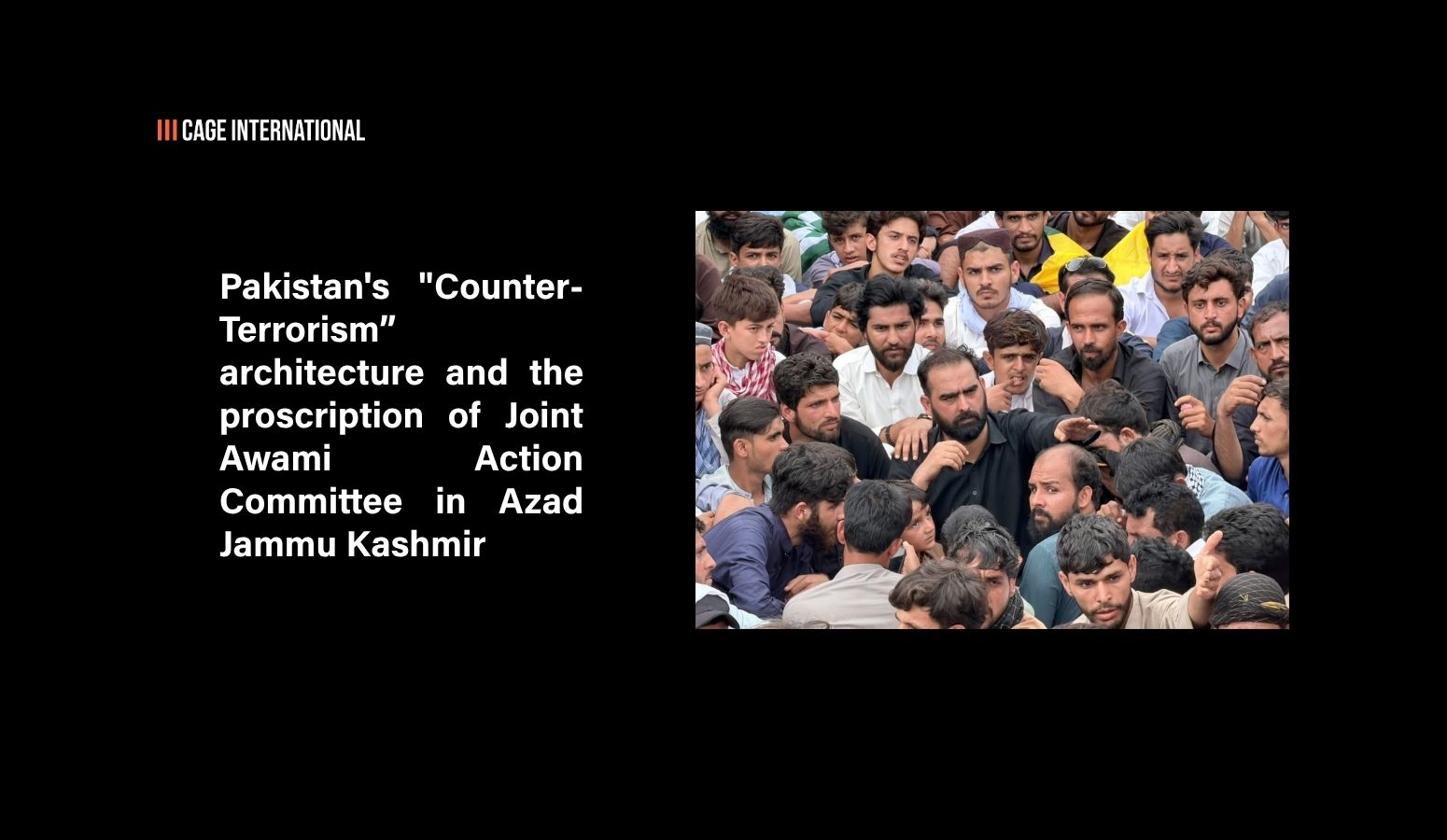

- On 5 June 2026, the same day Pakistan announced elections for the Legislative Assembly of Azad Jammu and Kashmir (AJK), the AJK government proscribed the Joint Awami Action Committee (JAAC) - a grassroots platform campaigning against inflation, electricity tariffs, and the 12 assembly seats reserved for non-resident refugees - as a terrorist organisation under the region's Anti-Terrorism Act 2014.
- More than 50 people have been killed in the crackdown that followed; the government has not released an official toll.
- Former senator Mushtaq Ahmad Khan, founder of the Pakistan Rights Movement, was stopped at Azad Pattan Bridge on 28 July while travelling to visit bereaved families in AJK, denied entry, then intercepted again near Kahuta and held for hours with his whereabouts undisclosed. He was later charged under Section 7 of the Anti-Terrorism Act over a Kashmir solidarity rally, with prosecutors alleging he was "working together with" the banned JAAC.
- The JAAC ban is the third proscription of a civilian rights movement under Pakistan's Anti-Terrorism Act in under two years: the Pashtun Tahafuz Movement was banned in October 2024, and members of the Baloch Yakjehti Committee - including its chief organiser, physician and two-time Nobel Peace Prize nominee Dr Mahrang Baloch - have been prosecuted under the same law, culminating in a life sentence handed down by a Quetta anti-terrorism court on 22 June 2026 after what Amnesty International called an expedited secret trial held on jail premises, with no direct evidence linking her to the violence she was convicted over.
- Pakistan's defence minister has ruled out negotiation with JAAC, describing protesters as being "in the same category as India" - a marked shift from two earlier rounds of JAAC-led protest, in 2024 and 2025, which both ended in talks and concessions.
Pakistan's Anti-Terrorism Act was drafted, financed, and internationally legitimised on the premise of fighting al-Qaeda and the Taliban on the Afghan border. Terms like "acts prejudicial to peace" and "creating a sense of insecurity" are more than a decade into the Act's life. Vagueness of this kind lets the state fold a wheel-jam strike, an election boycott, and a solidarity rally into the same legal category as armed insurgency, without ever having to prove the difference.
Read on its own, the AJK ban could look like an isolated overreaction to a strike that got out of hand. It is not. It is the third time in under two years that Pakistan has proscribed a civilian rights movement under this same law. In October 2024, the federal government banned the Pashtun Tahafuz Movement, a Pashtun rights group demanding an end to enforced disappearances. In Balochistan, the state has run an equivalent playbook against the Baloch Yakjehti Committee: on 22 June 2026, an anti-terrorism court in Quetta sentenced the group's chief organiser, Dr Mahrang Baloch - a doctor, a two-time Nobel Peace Prize nominee, and the most recognisable face of Balochistan's missing-persons movement - to life imprisonment, in a trial Amnesty International and UN human rights experts both condemned as a grave miscarriage of justice. Over a hundred Pashtun and Baloch activists have separately been added to a "proscribed persons" list under the same Act, stripping them of freedom of movement and association without a trial. The AJK ban is not a new tactic. It is a template Islamabad had already tested twice before it was applied to Kashmir.
That template has a longer history than either of those two rounds. The machinery now being used against a strike over electricity prices is the same machinery that produced Pakistan's first wave of War on Terror-era enforced disappearances two decades ago - the wave that led Amina Masood Janjua to found Defence of Human Rights Pakistan in 2006, after her husband was disappeared by the security services the year before. What is happening to JAAC in 2026 is the latest point on a continuum that runs back to the earliest years of the War on Terror, when a law with no need to distinguish an insurgent from a civilian was first turned on people who were neither.
Across the years the PTM ban and the Baloch prosecutions were under way, Pakistan's military and intelligence relationship with Washington continued largely undisturbed. Army Chief Asim Munir's reception at the White House and a revived US-Pakistan Counterterrorism Dialogue in 2026 occurs at a time when the same legal machinery is being turned on Kashmiris.
The proscription of civil liberties groups illustrates the deep-rooted lack of regard for the rule of law that exists within the Pakistani establishment. The continued oppression of civilian rights movements must not be tolerated and is an abuse of the enormous powers granted to itself by a Garrison state. The people of AJK are the latest victims of a ruthless state that continues to deploy barbaric policies to thwart legitimate concerns of its beleaguered population. Army Chief Asim Munir may be Trump’s beloved Field Marshall, but his actions continue to eviscerate any hopes of justice for the population that has to endure his inhumanity.
Download Files


