


Fahad Ansari Goes to Court of Appeal After High Court Rubber Stamps Security State Impunity
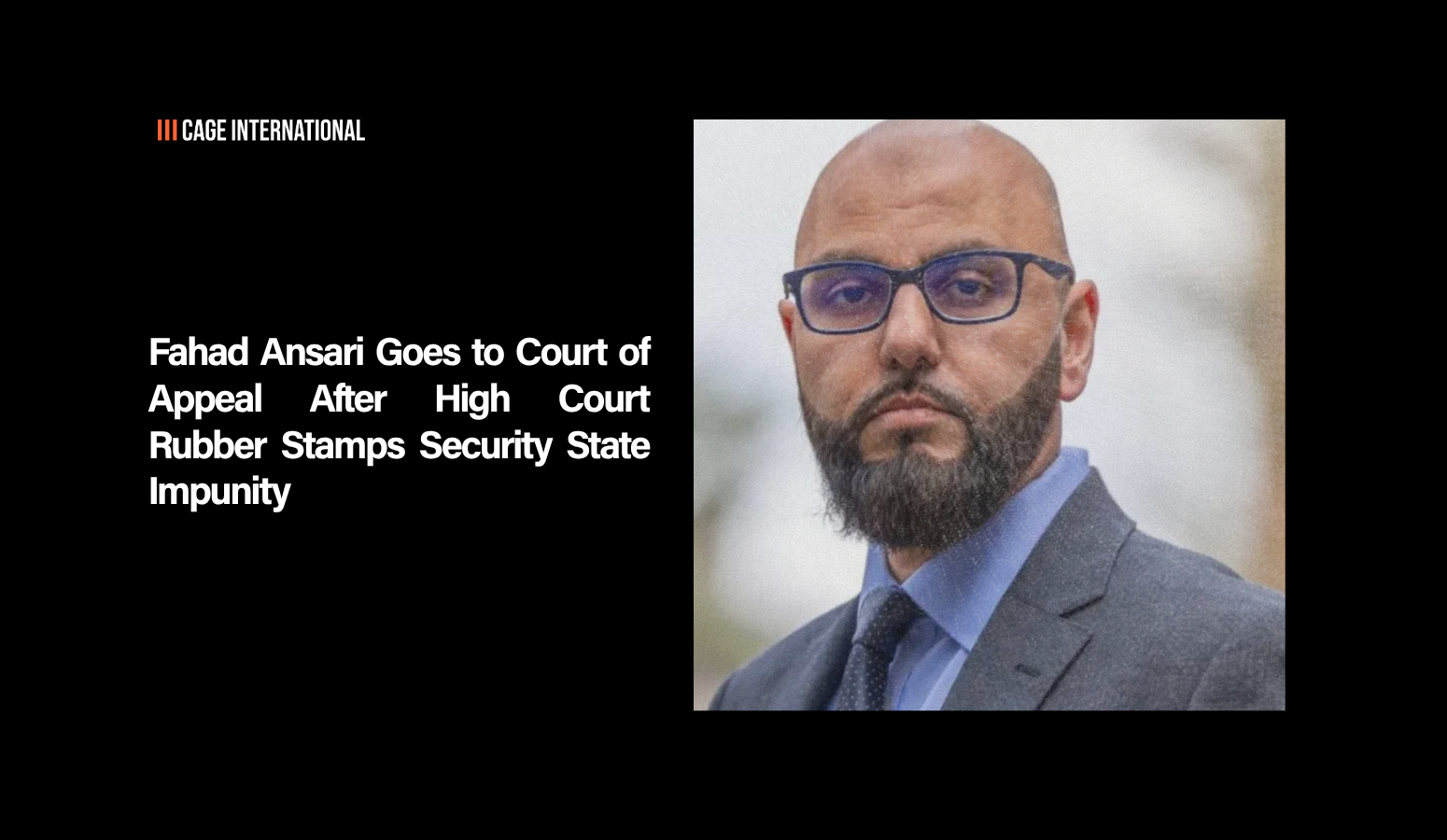

London — The High Court has refused Fahad Ansari permission to appeal its March ruling, which determined that the AF (No. 3) disclosure standard - requiring the state to provide an individual with sufficient information about the secret case against them to enable meaningful legal challenge - does not apply to Schedule 7 judicial review claims.
The March ruling means that where the state relies on secret evidence to justify a Schedule 7 stop, it is under no obligation to provide the individual with even a gist of the allegations against them. In contrast, those who refuse to provide passwords to their devices in compliance with Schedule 7 and face criminal charges enter the ordinary criminal justice process - where they receive full disclosure of the case against them, can cross-examine officers, and are given reasons for the stop. The court has created a situation in which those who engage with the law in good faith and challenge their detention through judicial review are afforded fewer protections than those who are prosecuted for refusing to comply.
This ruling is the judiciary's rubber stamp on the punishment of a lawyer whose crime, in the eyes of the security state, is representing clients it would prefer went unrepresented. The refusal to grant Fahad Ansari permission to appeal rewards a security state keen to penalise those who challenge its excesses.
Fahad Ansari said:
"This perverse ruling turns the law on its head: those who refuse to hand over their passwords are rewarded with greater protections, while those who comply are stripped of them. The former can challenge their detention and test the evidence against them; the latter are left in the dark with no reasons, no scrutiny, no accountability. By refusing permission to appeal, Judge Chamberlain has entrenched that injustice and sent a dangerous message: comply with the law and lose your rights; break it and gain protection. We will now take this challenge directly to the Court of Appeal to correct this perversity, and to make the law make sense again."
Schedule 7 of the Terrorism Act 2000 is one of the most sweeping and least scrutinised powers in Britain's counter-terrorism arsenal. It requires no suspicion of wrongdoing. It carries no right to silence. It compels individuals - at ports and airports - to answer questions, hand over devices, and submit to examination, on pain of criminal sanction. Today's ruling rubber stamps an incremental growth in the power of the security state to bypass accountability - one that has now reached so far as to taint the independence of the judiciary itself. This erosion of due process did not happen overnight. It is the product of two decades of laws and policies built on the exploitation of fear and prejudice against Muslims - a slow, deliberate dismantling of the very protections the law is supposed to guarantee.
Anas Mustapha, Head of Public Advocacy at CAGE, said:
"This decision is one moment in a much longer pattern. The security state has expanded its reach incrementally - through legislation, through policy, and through judicial endorsement - until the safeguards that are supposed to constrain it have been hollowed out almost entirely. We saw this most recently in the raid on the office of a Special Advocate by MI6 and MI5 - seizing privileged legal files and threatening the barrister involved with referral to her regulator - a case that is also before Mr Justice Chamberlain. The same judge who today refused to allow scrutiny of secret evidence used against a Schedule 7 detainee is also considering whether the intelligence agencies can raid a lawyer's office with impunity. These cases are not isolated, but rather a portrait of a security state that has has destroyed all accountability mechanisms: Parliament, media and judiciary"
Chronology of events
- On 7 April 2026, Mr Justice Chamberlain refused Fahad Ansari permission to appeal his earlier ruling of 4 March 2026
- The March ruling held that the disclosure standard established in AF (No. 3) - which requires that where the State relies on secret evidence, an individual must be given enough information to understand and challenge the case against them and properly instruct their lawyers - does not apply to judicial review claims arising under Schedule 7.
- This is the first time any court has made this determination, acknowledged by the judge himself
- The final hearing on 6-7 May will proceed as scheduled
- Ansari will now take the challenge directly to the Court of Appeal
- The case originated from his detention at Holyhead Port in August 2025, believed to be the first targeted use of Schedule 7 powers against a practising solicitor, during which his work phone containing fifteen years of legally privileged client material was seized
Download Files


