


Moog 4 denied due process as judiciary covers for genocide - retrial confirmed for early 2027
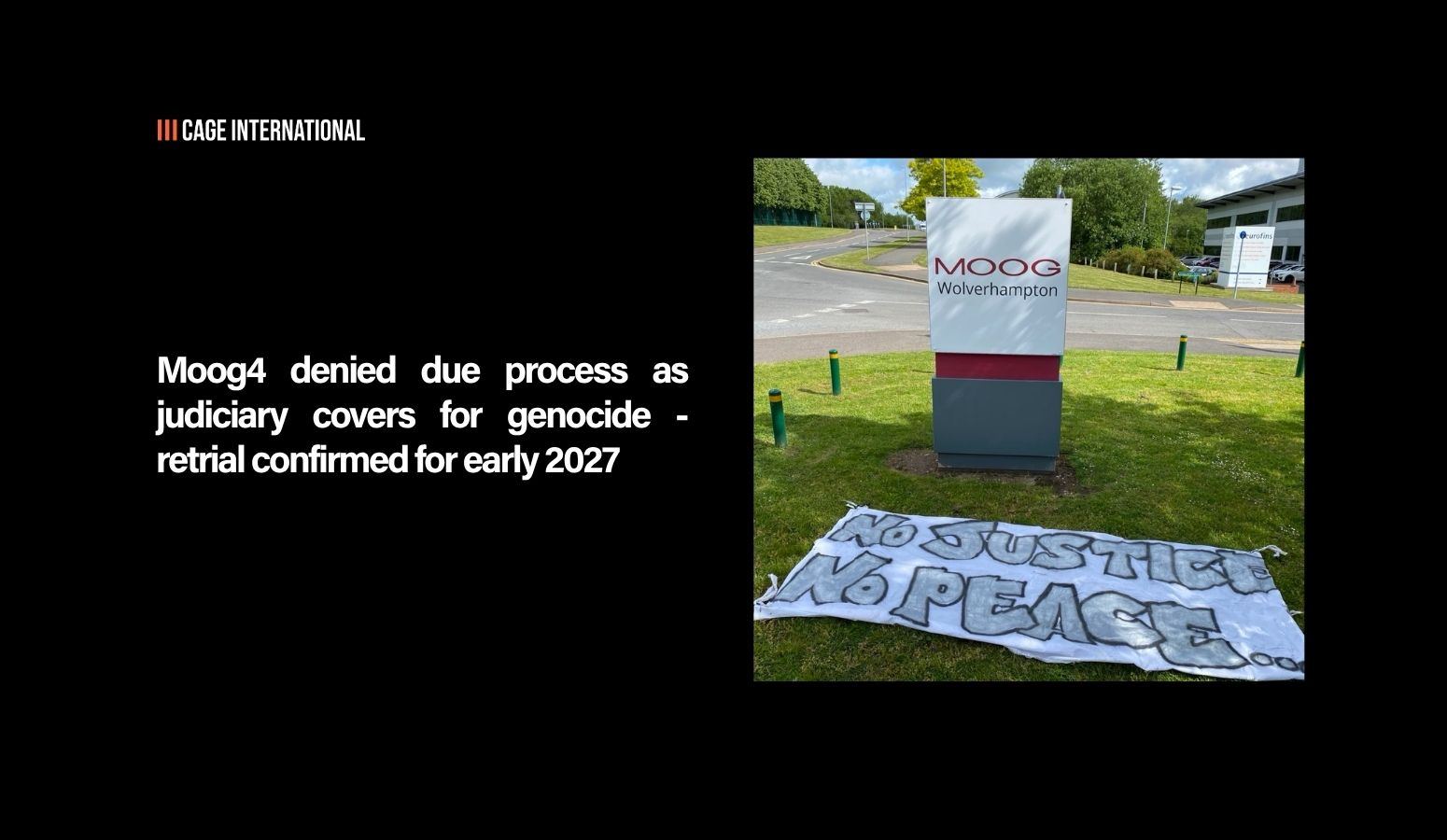

- Iain Evans, Frank Sherman, Hana Yun Stevens, and Hisham Alkhamesi will face retrial in early 2027 following today's hearing at Birmingham Crown Court
- The four spent six months on remand following their August 2025 direct action at Moog Aircraft Group's Wolverhampton facility, followed by three months under stringent bail conditions including non-association orders between co-defendants
- The jury at their trial asked Mr Justice Wall why the defendants were not granted a lawful excuse, and what an example of damage with lawful excuse would be - questions he declined to answer
- Other direct action cases heard this year - including Grid2 and Discovery5 - resulted in acquittals where lawful excuse defences were granted
- Four defendants in the Filton 6 case were remanded immediately after a guilty verdict and subsequently sentenced under terrorism provisions - a precedent the Moog 4 now face
Birmingham — The legal manoeuvres deployed to deny due process for the Moog 4, whose retrial has been confirmed for early 2027 at Birmingham Crown Court, expose a judiciary only too willing to provide institutional cover for the British state's complicity in Israel's destruction of Gaza.
In August 2025, Iain Evans, Frank Sherman, Hana Yun Stevens, and Hisham Alkhamesi broke into Moog Aircraft Group's Wolverhampton factory, scaled the roof, cut holes in it, and smashed solar panels and windows - acting to dismantle a direct link in the supply chain sustaining Israel's genocide in Gaza. Moog had been shipping military components from Britain to maintain aircraft used to train Israeli fighter pilots, whose F-16s and F-35s have been central to the sustained bombardment of Gaza.
At trial, the prosecution reduced the case to two questions: did the defendants cause damage, and did they intend to? The Moog 4 admitted both. The question the prosecution refused to engage with, and that Mr Justice Wall refused to answer when the jury raised it, was why they were denied a lawful excuse. The jury asked directly: why was no lawful excuse granted, and what would one look like? Mr Justice Wall declined to answer, telling the jury the question was beyond the scope of their consideration. It was not a peripheral matter. It was the heart of the case. The denial of that defence, and the refusal to explain it, is precisely the kind of legal manoeuvre that strips defendants of due process and forecloses the jury's ability to reach a genuinely informed verdict.
This follows a pattern established through the Filton 6 proceedings, in which legal defences were stripped from defendants before trial, a guilty verdict secured, and four defendants remanded immediately before being sentenced under terrorism provisions. CAGE has documented extensively how terrorism logic is primed to criminalise protest and direct action - by design.
One of the Moog 4 issued a statement ahead of today's hearing:
"After being held in prison on remand for six months, and then three months under stringent bail conditions including non-association orders between co-defendants, we went to trial pleading not guilty to criminal damage. The prosecution tried to make it out like a simple case. We scaled Moog Aerospace Wolverhampton's facility, occupying the roof. We cut holes in the roof and smashed solar panels and windows. We all admitted that we caused damage and intended to. Those two factors were listed to the jury, by the judge and prosecution, as the only relevant factors determining our verdict.
The jury heard that we had no lawful excuse. During deliberation, they posed these questions to the judge: why were we not given a lawful excuse? What would an example of damage with lawful excuse would be? He did not answer these questions with the reasons and information the jury asked for. Instead, he suggested this was beyond the scope of the jury to consider. Maybe if he had answered those questions, the arbitrary nature in which damage without lawful excuse is being applied would have been exposed.
Our case is no different to other direct action cases where legal defences have been granted - defendants acted to protect life and property and prevent further harm. Grid2 and Discovery5 had trials this year with these legal defences for criminal damage and were acquitted by a jury. What is happening with our case is symptomatic of the precedent set by the trials of the Filton 6, with legal defences being taken away, and then on a guilty verdict, four defendants remanded immediately before being sentenced as terrorists.
CAGE provides many testimonies as to how the British establishment has long used the Terrorism Act as a tool of foreign policy - using police powers to target Muslims, Black and Brown peoples, engineering an ecosystem that makes genocide and colonisation culturally acceptable. There are many layers of oppression at work when it comes to the government's failure of their duty to prevent genocide, but direct action cuts through all of them.
I felt nauseous and uneasy as we drove near the Moog factory, knowing that my life would be forever changed by the consequences that might come. But I knew that getting to the source itself - dismantling Moog's factory supplying genocide - would strengthen the tapestry in which collectively a new ecosystem is built, liberated from the shackles of racial capitalism and genocide."
The Moog 4 have already faced prison, bail conditions designed to isolate them from one another, and a trial in which the most important question, whether they had a lawful right to act, was ruled off limits. The CPS now wants to put them through it again, as they did with the Filton 6 when the state didn’t get their desired outcome.
[ENDS]
Download Files


