


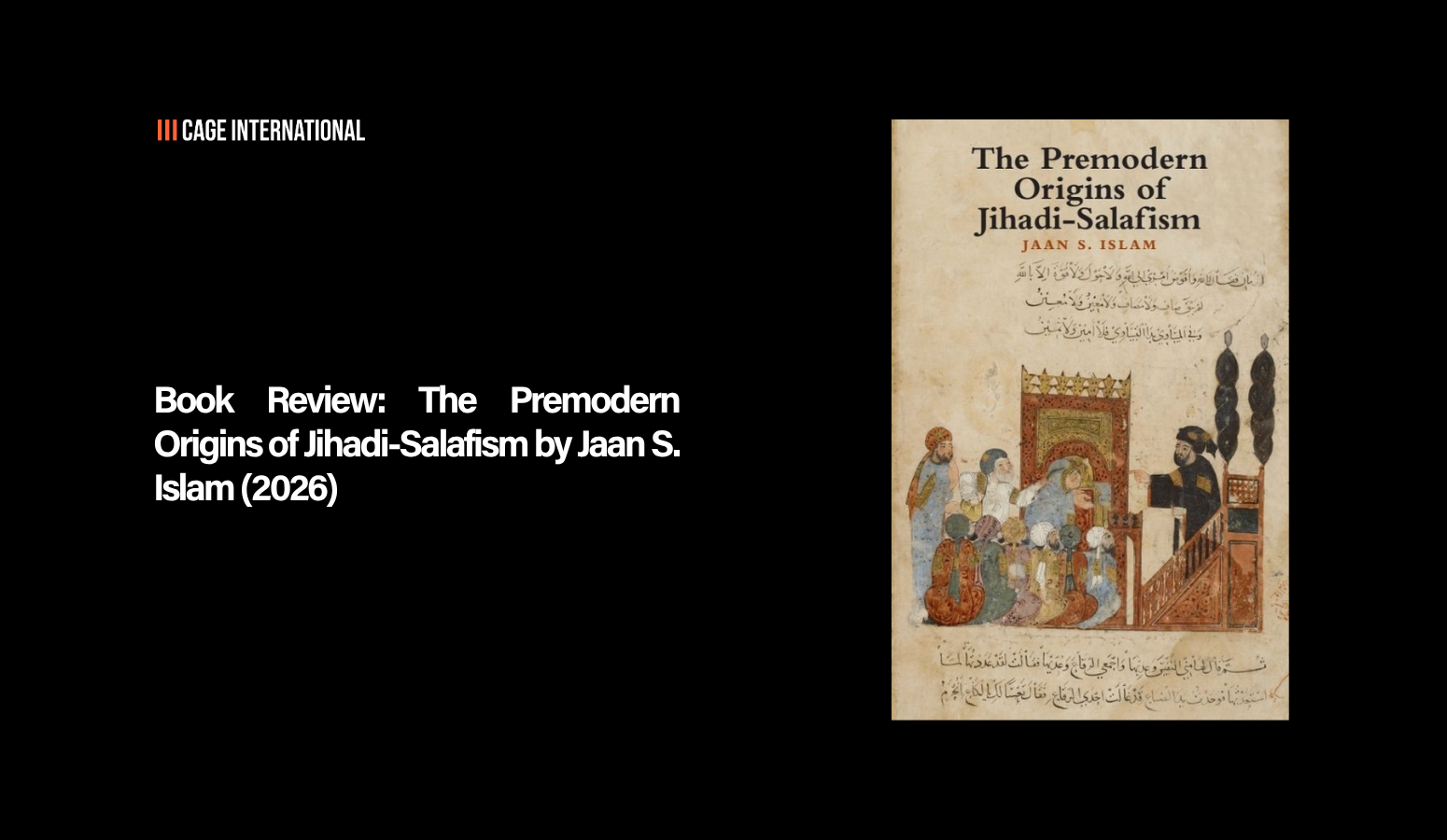
Book Review: The Premodern Origins of Jihadi-Salafism by Jaan S. Islam (2026)

Reviewed for CAGE by Dylan Evans
Published by Edinburgh University Press, January 2026 (Hardback)
https://edinburghuniversitypress.com/book-the-premodern-origins-of-jihadi-salafism.html
Academic writing on contemporary mujahideen has become surprisingly predictable. Whether produced by terrorism studies specialists, security analysts or journalists, most accounts rehearse the same familiar genealogy: Ibn Taymiyya gives way to Muhammad ibn Abd al-Wahhab, who in turn inspires Sayyid Qutb, culminating in al-Qaeda and the Islamic State. This linear narrative has become so deeply embedded within both academic literature and public discourse that it is rarely questioned.
Jaan S. Islam's The Premodern Origins of Jihadi-Salafism represents one of the most ambitious attempts yet to overturn that consensus. Meticulously researched, intellectually provocative and methodologically sophisticated, it argues that the standard genealogy is not merely incomplete but fundamentally misconceived. Rather than tracing contemporary Sunni militant thought to a handful of modern ideologues, Islam reconstructs an intellectual history stretching across nearly a millennium of Sunni jurisprudence, theology and political thought.
The result is a genuinely revisionist work in the best sense of the term. Whether or not every reader accepts its conclusions, it is hard to imagine anyone seriously interested in Islamic intellectual history reading it without having some of their assumptions challenged.
The book's central target is what Islam regards as the conceptual poverty of contemporary terrorism studies. He argues that prevailing scholarship has reduced a rich and internally diverse intellectual tradition to a simplistic ideological lineage. As he observes early in the book, contemporary scholarship often employs "conceptually shallow methodologies, in trying to construct a meta-narrative of Jihadi-Salafism, [that] turn a blind eye to centuries of Islamic scholarship."
This critique establishes the book's central ambition. Rather than explaining contemporary militant movements primarily through modern political ideologies, Islam proposes studying them as participants in a much older scholarly conversation. The focus therefore shifts from organisations, recruitment and radicalisation to legal theory, Qur'anic exegesis, political jurisprudence, and theology.
One of the book's greatest strengths is its insistence that contemporary militant scholars should be treated as intellectual actors rather than simply as security threats. Islam writes:
"The intellectual historian's journey ought to be defined by openness in uncovering multilayered, intellectual realities often obscured under the distractions of political slogans and generalisations."
This commitment to intellectual history distinguishes the work from much of the existing literature. Instead of asking how dangerous particular individuals or organisations may be, Islam asks what texts they read, which jurists they cite, how they interpret inherited legal traditions, and where those traditions originated. It is an approach that feels refreshingly historical.
Perhaps the book's most original contribution lies in its reconstruction of Sunni intellectual genealogy. Rather than locating contemporary Salafi-mujahid thought exclusively within Hanbali or Wahhabi traditions, Islam traces influences through Seljuk political jurisprudence, Mamluk legal theory, Ottoman political thought, Indian Hanafi and Deobandi scholarship, Shafi'i-Ash'ari theology, and nineteenth-century reformist movements.
This is far more than an exercise in source criticism. By demonstrating the diversity of the traditions upon which contemporary militant scholars draw, Islam fundamentally alters the way the reader understands Salafism itself. Rather than treating it as a fixed ideology or sectarian identity, he argues that it functions primarily as a hermeneutical method—a way of reading scripture that is capable of drawing upon scholars from across the Sunni tradition whenever their interpretations are judged faithful to the Qur'an and Sunnah.
Equally striking is the author's refusal to caricature the people he studies. He writes:
"Mujahideen are ordinary Muslims who, like their co-religionists, grapple with interpreting, borrowing from and negotiating between the diverse ideas found within the rich tapestry of Islamic thought."
Whether readers ultimately sympathise with these actors is beside the point. The author's achievement lies in restoring their intellectual agency. They cease to appear as ideological automatons programmed by a handful of modern thinkers and instead emerge as participants in long-running debates within Sunni jurisprudence.
The same commitment to intellectual seriousness appears in the book's treatment of concepts such as divine sovereignty (ḥākimiyya), the implementation of the Sharīʿa, rebellion, apostasy and the caliphate. Rather than accepting the widespread assumption that these ideas originated with twentieth-century Islamist thinkers such as Maududi or Sayyid Qutb, Islam painstakingly demonstrates their much deeper roots within classical Sunni legal literature.
This historical reconstruction represents one of the book's most significant scholarly contributions. It shifts the debate away from simplistic questions of ideological invention towards the more historically interesting question of intellectual inheritance.
One of the book's most controversial—and, in many ways, most refreshing—features is its explicit critique of terrorism studies as a discipline. Islam argues that the field has become so closely intertwined with the priorities of modern security states that it has developed a vocabulary incapable of understanding the intellectual worlds inhabited by the people it studies. Instead of beginning with indigenous categories rooted in Islamic jurisprudence, it imposes externally constructed labels such as "Islamism" and "jihadism", categories which he argues obscure far more than they illuminate.
His methodological alternative is both bold and consistent. Rather than adopting the language of contemporary security discourse, he deliberately employs the term mujahid because it reflects how the actors themselves understand their place within the Islamic legal tradition. This is not simply a semantic preference but an epistemological commitment. As he explains, "Concepts like jihadism, Islamism and similar terms serve as tools in the arsenal of academia to reinforce what Mahmood Mamdani identified as the 'good/bad' Muslim dichotomy."
Islam's ethical argument for rejecting the language of contemporary security discourse is even more powerful. His refusal "to utilise a methodology that aims for the physical elimination of the research subject" is a direct critique of terrorism studies as an academic field. Islam is suggesting that much of that literature is not simply explanatory but is institutionally connected to counter-terrorism policy, intelligence, and military practice. If a discipline ultimately serves to identify, target, and eliminate the people it studies, then, in his view, this raises serious ethical questions about adopting its categories uncritically.
One need not agree with every aspect of this argument to appreciate its importance. At the very least, Islam forces readers to recognise that terminology is never neutral. Every vocabulary carries with it assumptions about what questions deserve to be asked and what kinds of answers are likely to emerge. His determination to reconstruct the intellectual universe of his subjects from within rather than from without gives the book an unusual degree of coherence.
This becomes especially apparent in his sustained engagement with one of the dominant narratives within both academic and Muslim apologetic literature: the claim that contemporary militant movements represent a radical break with the classical Islamic tradition. Islam argues that this is precisely the wrong way to understand the historical evidence. Rather than rejecting classical jurisprudence, contemporary Salafi-mujahid scholars immerse themselves in it, drawing upon centuries of legal manuals, theological debates and exegetical traditions. Their ideas are certainly modern in their application, but their intellectual resources are overwhelmingly premodern.
The prose throughout is confident without becoming polemical. Islam is plainly advancing a controversial thesis, yet he generally avoids caricaturing opposing scholars. Even when criticising terrorism studies, he prefers careful methodological argument to rhetorical denunciation. The result is a work that feels scholarly rather than ideological, despite addressing one of the most politically charged subjects in contemporary academia. The book's real achievement, however, lies elsewhere. Islam has produced a work that compels readers to rethink some of the most deeply entrenched assumptions about the intellectual origins of contemporary Sunni militant thought. Rather than reducing a complex tradition to a handful of modern ideologues, he restores centuries of legal, theological and philosophical debate to the centre of the discussion.
Perhaps the book's greatest accomplishment is that it succeeds in changing the questions we ask. Instead of asking, "Which modern ideologue inspired whom?", readers are encouraged to ask, "Which premodern intellectual traditions are being inherited, reinterpreted and contested?" That shift in perspective opens entirely new avenues of research, not only for the study of Salafism but for Islamic intellectual history more generally.
Whether The Premodern Origins of Jihadi-Salafism ultimately reshapes the academic consensus remains to be seen. It certainly deserves to. Original works of intellectual history are surprisingly rare, and genuinely paradigm-challenging ones rarer still. Islam has produced a book that is deeply learned, meticulously documented and intellectually fearless. It does not ask readers merely to revise a few details of the prevailing narrative; it asks them to abandon that narrative altogether and replace it with one that is richer, more historically grounded and considerably more persuasive.
For scholars of Islamic law, political theology, Salafism, jihad studies and the history of Sunni thought, this is an indispensable book. Even readers who remain unconvinced by every aspect of its argument will come away with a far deeper appreciation of the complexity of the intellectual traditions that continue to shape contemporary debates. The hallmark of truly important scholarship is not that everyone agrees with it, but that nobody who has read it can continue thinking about the subject in quite the same way. By that standard, The Premodern Origins of Jihadi-Salafism is an outstanding achievement.
Download Files


