


Beyond Human Rights: An Islamic Reading of The Gaza Tribunal
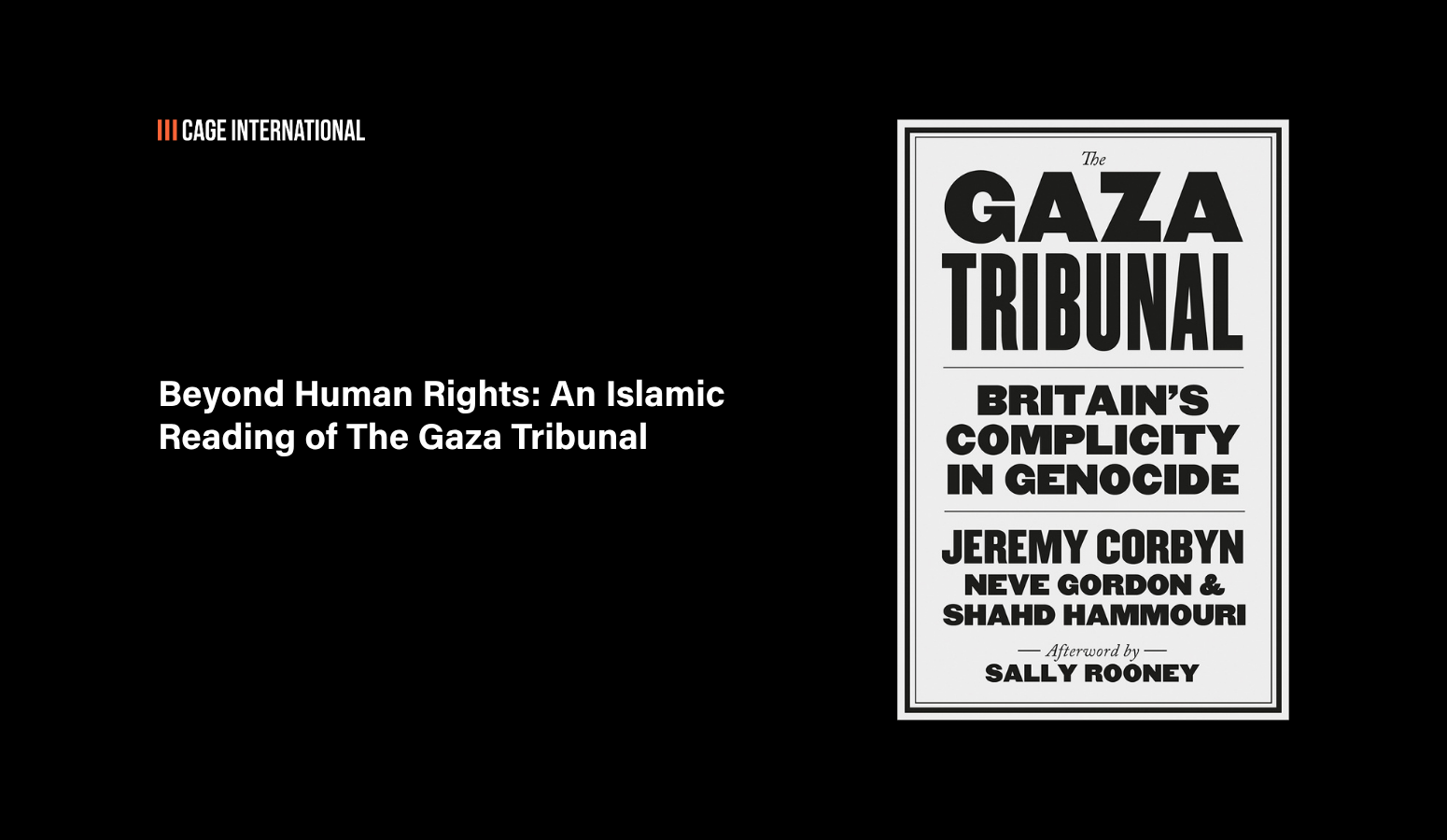

The Gaza Tribunal: Britain's Complicity in Genocide, by Jeremy Corbyn, Neve Gordon and Shahd Hammouri (Pluto Press, 2026)
Reviewed by Dylan Evans for CAGE
The Gaza Tribunal: Britain's Complicity in Genocide is an important and timely book. It deserves to be widely read, not only because of the seriousness of the case it advances, but because it attempts something that Britain's political establishment has consistently refused to do: investigate the United Kingdom's own role in the destruction of Gaza.
The Tribunal brought together lawyers, academics, doctors, journalists and eyewitnesses to examine Britain's complicity in Israel's military campaign. The resulting volume is a substantial work of legal argument, historical documentation, and political indictment. It contends that Britain's support for Israel – through intelligence cooperation, military assistance, diplomatic cover and political backing – has rendered it complicit in grave breaches of international law.
There is something striking here from the perspective of Islamic legal thought. The modern international legal system repeatedly presents atrocities as claims requiring authoritative investigation and adjudication before they can acquire the status of established fact. The Islamic jurisprudential tradition possesses another important epistemic category: tawātur, the convergence of testimony from sufficiently numerous and independent sources to produce knowledge that cannot reasonably be dismissed as uncertain.
Al-Ghazālī expresses the classical principle succinctly: al-tawātur yūjib al-ʿilm al-ḍarūrī – mass-transmitted testimony produces necessary knowledge. The point is not that tawātur can simply substitute for the technical requirements of a modern court. It is that there comes a point at which endlessly demanding further proof can itself become morally significant. When suffering has been witnessed, filmed, documented and independently reported on an overwhelming scale, the ethical question is no longer simply how much more evidence is required, but what obligations arise from what we already know.
As an exercise in public accountability, The Gaza Tribunal is exemplary. It marshals an impressive body of evidence and demonstrates how legal scholarship can be deployed in the service of justice. Yet from an Islamic perspective, it also invites a further conversation. The Tribunal speaks primarily in the language of international law, human rights, and political accountability. These are powerful pragmatic tools for confronting injustice within the existing international order. Islamic ethics, however, offers an additional moral vocabulary capable of deepening the questions the Tribunal asks.
This is not a criticism of the Tribunal's evidence, much of which is meticulously documented. Nor is it an argument for abandoning international law. Muslims have every reason to support legal norms that protect human life, restrain state violence and provide mechanisms through which perpetrators may be held accountable. Justice should be welcomed wherever it is found. At the same time, legal argument cannot exhaust the moral significance of what has unfolded in Gaza.
The Tribunal presents Gaza primarily as a legal catastrophe. An Islamic perspective sees this too, but also something more: a profound moral and spiritual collapse. Islam does not begin with treaties or conventions. It begins with ʿadl and qisṭ (justice and equity), amānah (trust), ḥaqq (right and truth), and the Qurʾanic insistence that oppression (ẓulm) corrupts human relationships and political authority alike.
The concept of amānah is particularly important. State power is not morally self-authorising. Human beings exercise authority conditionally, as a trust for which they remain accountable before God. Political power therefore cannot make an injustice just simply by legislating for it, nor can state sovereignty transform assistance in wrongdoing into morally neutral policy.
This gives Britain's involvement a further ethical dimension. The Qurʾān commands believers to “cooperate in righteousness and piety” but not to “cooperate in sin and aggression” (5:2). Muslim jurists developed the corresponding principle that assistance in wrongdoing – al-iʿāna ʿalā al-maʿṣiya or al-iʿāna ʿalā al-ithm – can itself constitute wrongdoing. From this standpoint, the questions raised by British intelligence cooperation, military assistance, and diplomatic support do not begin and end with whether ministers have crossed the threshold for legal complicity under international law. They also concern the moral responsibility incurred by enabling injustice.
This distinction becomes particularly important when we consider the preservation of life. International humanitarian law necessarily contains doctrines for adjudicating the permissible use of force, including proportionality. Islamic jurisprudence has its own complex traditions concerning warfare and proportionality, and it would be misleading simply to contrast an uncompromising Islam with a permissive international law. But the maqāṣid al-sharīʿa tradition nevertheless places the preservation of human life – ḥifẓ al-nafs – among the fundamental necessities that law exists to protect. Al-Shāṭibī treats the preservation of life as one of those indispensable goods without which human social existence itself becomes corrupted.
The difference, then, is partly one of moral orientation. International law asks under what conditions violence becomes unlawful. Islamic ethics also asks what human beings owe to life, to the oppressed, to the trust placed upon them, and ultimately to God. It asks not merely where the outer boundary of permissible conduct lies, but what justice positively requires.
One of the book's greatest strengths is its postcolonial analysis. Gaza is not presented as an isolated tragedy beginning on 7 October 2023, but as the latest chapter in a much longer history shaped by the Balfour Declaration, British imperial rule, settler colonialism, and an international order that has repeatedly privileged Western power. In doing so, the Tribunal rejects the comforting fiction that Britain has merely been an impartial observer of events in Palestine.
For British Muslims, this history also has a domestic dimension. The foreign-policy architecture developed through empire and the post-9/11 War on Terror has been accompanied by an expanding domestic counter-terrorism apparatus through which Muslim political speech and activism have frequently been viewed through the language of security and extremism. Palestine therefore sits at an important intersection between foreign and domestic policy. The same state that helps determine the permissible boundaries of violence abroad also possesses considerable power to determine which forms of Muslim political mobilisation at home are regarded as legitimate, suspicious or extreme.
Many Muslim readers will recognise the broader postcolonial argument immediately. Anti-colonial thinkers across the Muslim world have long observed that international law has functioned not only as a restraint upon imperial power but also, historically, as one of its instruments. Colonial conquest was repeatedly justified in the language of civilisation, progress, and order. Today, military intervention is more commonly defended in the language of democracy, security, and human rights. The vocabulary changes; asymmetries of power remain.
The Tribunal's analysis therefore prompts a larger question. If the post-war international order repeatedly proves incapable of restraining its most powerful members and their allies, should Muslims regard that order as the ultimate source of moral legitimacy? Or should international law instead be understood as one potentially valuable human attempt to institutionalise goods – protection of civilians, limitation of violence, observance of agreements – that Islamic ethics can independently recognise as good?
This latter possibility avoids a false choice between Islam and international law. Muslims need not regard the Geneva Conventions as sacred texts in order to recognise the moral goods that many of their provisions seek to secure. Islamic jurisprudence has a long tradition of treaties, truces and agreements designed to reduce bloodshed and establish reciprocal obligations. Where human beings construct institutions that genuinely protect life and diminish injustice, Muslims have good Islamic reasons to support them. Their moral authority, however, derives ultimately from the justice they serve, not simply from the institutions that promulgate them.
This brings us to an aspect of the Palestinian experience that the Tribunal understandably explores less fully: Islam as an intellectual tradition. Palestinians appear throughout the book as victims, witnesses, and survivors, and rightly so. Their voices form the moral centre of the Tribunal's work. Yet relatively little space is devoted to the Islamic concepts through which many Palestinians and Muslims elsewhere understand not only oppression but also the obligation to resist it.
Classical Islamic jurisprudence speaks, for example, of dafʿ al-ṣāʾil: repelling an aggressor who threatens life, bodily integrity or property. The significance of the concept is that resistance is not understood merely as a discretionary political strategy granted legitimacy by the international system. Under appropriate circumstances, defending oneself and others against violent aggression becomes a moral obligation. This does not remove the ethical restraints governing resistance; on the contrary, Islamic jurisprudence surrounds the use of force with its own elaborate moral and legal constraints. But it changes the starting point. The oppressed are moral agents possessing duties and rights of their own, not merely populations awaiting protection from states and international institutions.
The Qurʾān makes this connection between justice and active solidarity with unusual force: “And what is the matter with you that you do not fight in the cause of God and for the oppressed among men, women and children?” (4:75). Bearing witness to injustice, on this account, cannot always remain a matter of observation. Knowledge generates responsibility.
This is why Palestine has never been merely another case study in international law for Muslims. It occupies a distinctive place within sacred history and religious consciousness, but the principle involved extends far beyond Palestine. The defence of the oppressed is not simply a political preference. It is a moral and religious obligation.
None of this requires Muslims to reject international law. A more fruitful relationship is possible. Islamic ethics can affirm those provisions of international law that preserve life, restrain violence, and protect the vulnerable while simultaneously retaining an independent standpoint from which existing institutions can themselves be judged. The relationship is therefore neither simple rejection nor unquestioning adoption.
This distinction matters, because Gaza has exposed something more troubling than the occasional malfunction of a benevolent “rules-based international order.” It has raised the possibility that some of the inequalities revealed by the crisis are structural: that an international system may proclaim universal norms while distributing political power, coercive capacity, and effective accountability in a profoundly unequal manner. Critics of the modern human-rights movement, such as Makau Mutua, have long warned that ostensibly universal humanitarian discourses can reproduce older hierarchies between those empowered to define civilisation and those represented primarily as its victims.
Yet recognising this should not obscure the extraordinary importance of the work being done by lawyers, journalists, doctors, campaigners, and secular activists who have used precisely these legal institutions and languages to defend Palestinians. The Gaza Tribunal demonstrates the possibilities of such work. Its contributors have gathered evidence, preserved testimony, and challenged the British state in a political environment in which doing so has often carried considerable personal and professional costs. An Islamic critique worthy of the name should recognise such work as an ally in the pursuit of justice, not dismiss it because it proceeds from a different intellectual tradition.
For Muslim readers, then, the book's achievement may be twofold. It provides a formidable case concerning Britain's responsibility for Gaza, while also creating space for a richer conversation about the foundations of justice itself. Muslims should support serious attempts to use international law to protect Palestinians and hold governments accountable. But they need not imagine that the language of rights and legal obligation exhausts what can be said.
The Islamic tradition adds a further series of questions. What do we already know, and when does knowledge become an obligation to act? What does it mean to hold political power as an amānah? When does assistance to another become participation in their wrongdoing? What duties are owed to those facing aggression? What does the preservation of life demand of us? And before whom are rulers and citizens ultimately accountable?
The struggle for Palestine is undoubtedly a legal struggle. It is also a political struggle. Above all, however, it is a struggle over moral vision. In documenting Britain's complicity, The Gaza Tribunal has made an invaluable contribution to that struggle. An Islamic reading need not displace the framework the Tribunal employs. It can instead widen the horizon: from legality to ʿadl, from sovereignty to amānah, from passive knowledge to moral responsibility, and from the protection afforded by institutions to the obligation human beings themselves bear to stand against ẓulm.
Download Files


