


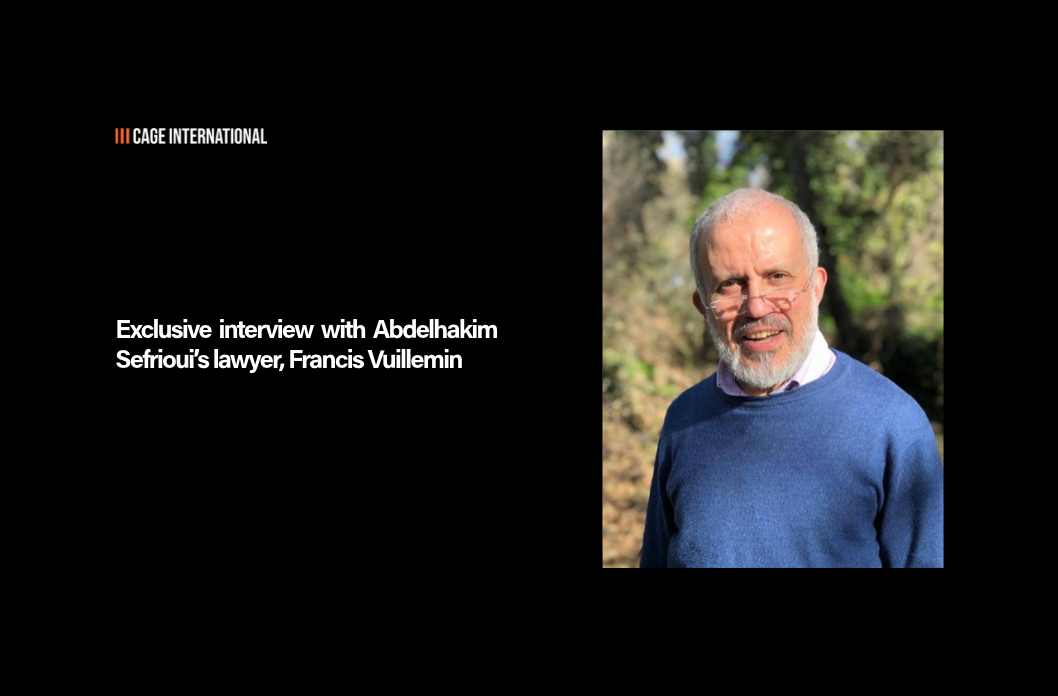
Exclusive interview with Abdelhakim Sefrioui’s lawyer, Francis Vuillemin

Abdelhakim Sefrioui is a French citizen of Moroccan heritage. In October 2020 he produced a video discussing the issue of a professor, Samuel Paty, showing a blasphemous image of the Prophet (peace be upon him) at a public secondary school. On the 16th of October, a man unconnected to Sefrioui and who had never seen his video killed the professor. Sefrioui was arrested the very next day and placed in police custody. He was placed in pretrial detention four days later, on the 21st of October.
Sefrioui was not accused of participating in the murder, nor of having any direct contact with the perpetrator. The prosecution concocted a narrative concerning his role in the campaign against Paty’s actions in the days preceding the attack.
On 20 December 2024, the Paris Special Assize Court convicted Sefrioui and sentenced him to 15 years’ imprisonment.
His appeal was heard before the Paris Special Assize Court from 26 January to 2 March 2026. On 2 March 2026, the court upheld his 15-year sentence for terrorist criminal association. On 4 March 2026, Sefrioui’s defence lodged an appeal before the Court of Cassation, challenging the legal reasoning underlying his conviction and aspects of the proceedings. The case therefore remains subject to potential review on points of law.
CAGE International conducted this exclusive interview with Francis Vuillemin, the lawyer of Abdelhakim Sefrioui to get the inside view of the latest on this important case:
Can you introduce yourself? How did you get involved in this case and why do you feel it is important?
I am Francis Vuillemin, a member of the Paris Bar for more than thirty years. I have handled difficult cases and sometimes very difficult clients — Maurice Papon, Ilich Ramírez Sánchez (known as "Carlos"), John Galliano, the Order of the Solar Temple massacres, and Ziad Takieddine, for example. These were judicially harsh trials that were highly exposed to media scrutiny and public condemnation. It is not entirely surprising that people close to Abdelhakim Sefrioui suggested my name to him.
The Paty case is crucial because it touches on public freedoms, in particular freedom of opinion and freedom to express outrage over certain discriminatory teaching methods that persist quietly within the French school system.
During the trial, you accused Samuel Paty of discriminating against Muslim pupils. Can you explain?
The case file — that is, the many witness statements, in particular from numerous students of Samuel Paty's over several years — establishes, in the clearest possible terms, that from 2017 onward at the Collège du Bois-d'Aulnes, across at least eight Year 8 (4ème) classes over four school years, the teacher made a first pedagogical choice: he decided to show three, sometimes four, Charlie Hebdo cartoons dealing exclusively with the Prophet Muhammad, and never touching on any other religion. This alone reveals a kind of unhealthy fixation targeting Islam, given that the variety of cartoon subjects available was entirely absent from his lessons on freedom of expression — it was Islam, and only Islam, and only [Prophet] Muhammad, nothing else.
This pedagogical choice was followed by a second one: he showed an almost pornographic cartoon of [Prophet] Muhammad, Here again, one might question the teacher's motives, but let me be clear: nothing about this was unlawful. He had the right to proceed this way.
Where things truly went wrong is that, before showing this "trash" cartoon — his own word for it — Samuel Paty systematically asked Muslim students to identify themselves (nearly twenty students affected by this practice have described it over several years) by raising their hands, and then suggested they leave the room if they thought they might be shocked. Almost all the Muslim students — generally five to seven per class — would then systematically leave the classroom. Some of them describe feeling obligated to do so "even though the teacher said it kindly," and others describe a feeling of humiliation and discrimination, particularly upon returning to the classroom after the sexualised cartoon of [Prophet] Muhammad had been shown, since they were then unable to take part meaningfully in the discussion with the other students — because the Muslim students didn't know what had actually been shown. A strange pedagogy indeed.
One day, when a light-skinned girl with a distinctly "French" first and last name raised her hand along with the other Muslim students in order to leave the room before the sexualised drawing of [Prophet] Muhammad was projected, Samuel Paty first told her, "No, not you!" — believing she was not Muslim — before finally allowing her to leave once she explained her religion: her French father had converted to Islam, and her mother, of Algerian origin, was already Muslim. In other words, only Muslim students were permitted by the teacher to leave the room — not students of other religious backgrounds.
This flawed pedagogical approach was carried out for years with hundreds of students, and — contrary to the media narrative pushed by the civil parties, their lawyers, and their political and opinion-shaping lobbies — this was not a one-off mistake by Samuel Paty. It was a discriminatory pedagogy directed at Muslim students, under the false pretext of supposedly protecting them from the pornographic shock of the image of the Prophet — an unacceptable teaching method within the schools of the Republic.
Despite acknowledging that the murderer had only seen Abdelhakim Sefrioui's video after the murder had been committed, the court handed down a surprisingly lengthy sentence. What legal mechanism was used?
I must point out that the trial clearly established that the terrorist Anzorov never saw Abdelhakim Sefrioui's video, either before or even after his crime. He was, in fact, shot dead within minutes of murdering Samuel Paty. The only video Anzorov watched was the one made by Brahim Chnina, the father of the young girl Zayna. In order to convict, in the same sweep, a family father (Chnina) and a Muslim rights activist (Sefrioui), French justice made extensive and, I would argue, unlimited and legally distorted use of the charge of association de malfaiteurs terroriste criminelle (criminal terrorist conspiracy — "AMT"). The court held that Mr Chnina and Mr Sefrioui had acted in a concerted manner by denouncing Samuel Paty's discriminatory teaching methods on social media, on the theory that they should have been aware of the terrorist risk hanging over France in relation to cartoons of [Prophet] Muhammad!
This is a wholly liberty-destroying application of the concept of criminal terrorist conspiracy — one that ends up convicting, as terrorists, a family father and a community activist who had strictly nothing to do with terrorism, but who were simply objecting — clumsily, certainly, but in no way criminally — to the discriminatory nature of Samuel Paty's lessons toward Muslim children.
Does this case highlight a wider, structural Islamophobic issue? Is the rule of law and due process truly applied to Muslims?
Yes — this case starkly exposes a structural Islamophobia within the French state, carried out through the armed wing of its anti-terrorism justice system, which applies a specific body of case law to one population: Muslims. I have even referred to the AMT as having become the "Association of Muslim Terrorists," to show just how far the special criminal court court twisted the law to fit a situation that had nothing to do with terrorism.
Because the Paty case can, in reality, be summed up in a few words: the young Zayna lied to her father, Brahim Chnina, about having attended Samuel Paty's class — but Zayna also told the truth in describing the discriminatory reality of that class, which had been taught this way for four years. Her father became upset and reacted on social media; Abdelhakim Sefrioui then joined this protest — a legitimate cause — including by requesting a meeting with the school's headteacher. But Anzorov, a young Chechen came across the controversy while browsing social media and, obsessed not with the discrimination (the sole concern of Chnina and Sefrioui) but with the semi-pornographic cartoon of his prophet, decided to behead the teacher. Chnina and Sefrioui have strictly nothing to do with the insane, autonomous decision of a terrorist who came out of nowhere.
Do you think his anti-Zionist advocacy was used against him?
Obviously. The prosecution and the civil parties made repeated and excessive use of attempts to link Palestinian resistance with terrorism, in order to tarnish Abdelhakim Sefrioui's image by any means possible — trying to associate him with a terrorist milieu that he has, on the contrary, always firmly condemned.
Does the judgement serve as an Islamophobic warning to politically active Muslims?
This judgment can certainly be seen as a cause for concern regarding freedom of opinion, freedom of religion, freedom of thought, the right to criticise, and the right to protest against discrimination while asserting rights that are sometimes entirely legitimate. Because no one is safe from a madman who emerges out of nowhere to carry out his madness, fuelled by the online frenzy of social media.
What are the next legal steps now open?
The appeal to the Court of Cassation, lodged immediately after the conviction, is currently under review. It raises numerous grounds, including in particular a strong challenge to the wildly extensive and liberty-destroying application of the charge of criminal terrorist conspiracy to individuals who never sought any form of physical violence against Samuel Paty. Their sole objective was to obtain disciplinary administrative sanctions against the teacher, and above all to put an end to this unfortunate pedagogical approach — one that everyone should agree posed serious problems.
Download Files


