


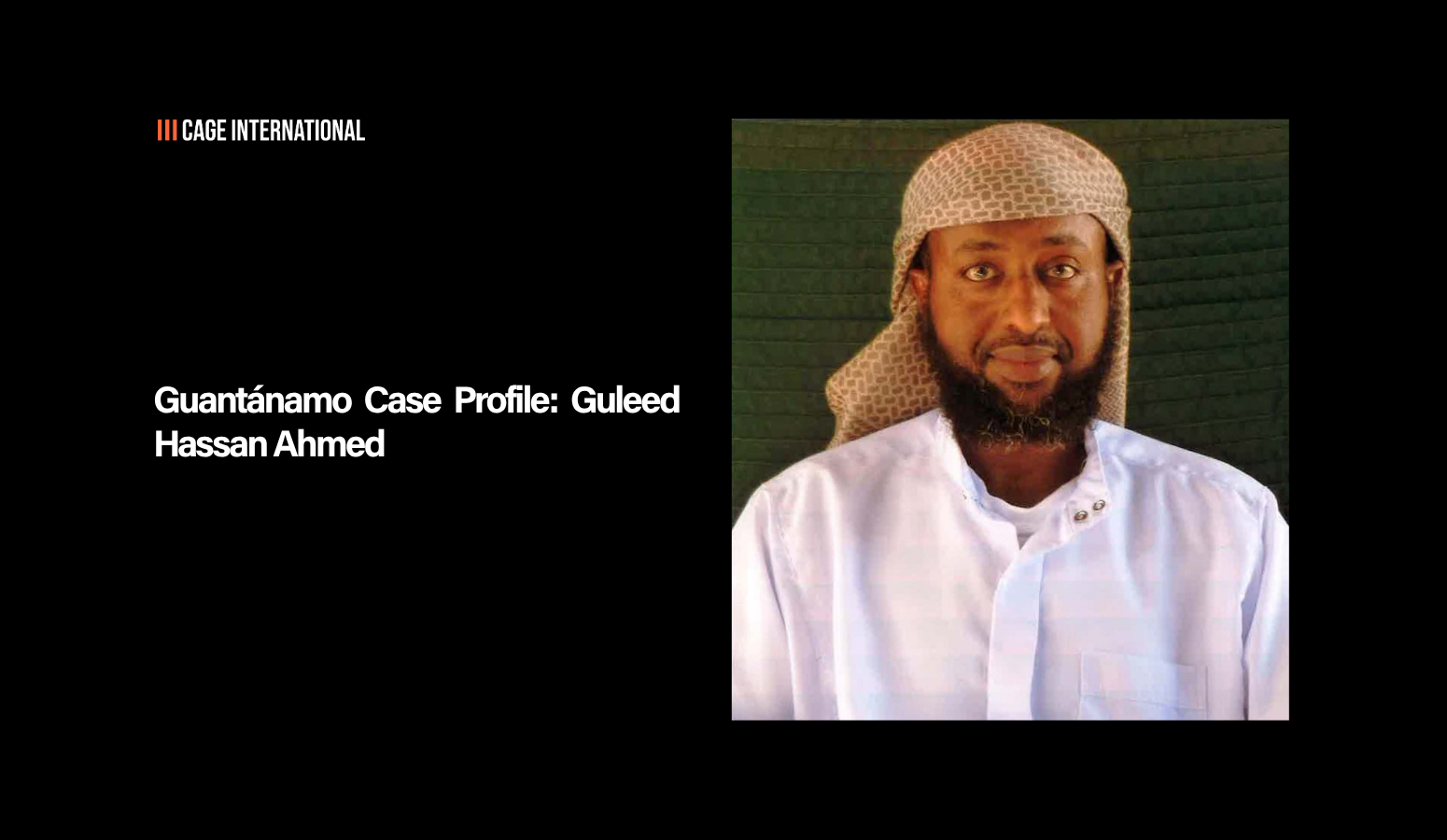
Guantánamo Case Profile: Guleed Hassan Ahmed

Summary
Guleed Hassan Ahmed (51) is a Somali father of four who was abducted in Djibouti in 2004 and handed over to the CIA, vanishing into the US network of secret “black sites.” For over two years, he was held incommunicado and subjected to torture. In 2006, he was transferred to Guantánamo Bay as a so-called “high-value detainee,” where he has since endured isolation, psychological torment, and lasting health damage.
Despite being imprisoned for 21 years without charge and the U.S. government determining in 2021 that Guleed poses no threat and should be released, he remains detained.
Background
Guleed Hassan Ahmed, also known as Gouled Hassan Douran (51) is a father. A young man born into a divided Somalia, he spent part of his youth in Sweden and Germany, gaining fluency in multiple languages - Somali, Arabic, English, and Swedish - and exposure to international culture.
But in 2004, everything changed. While on a visit to Djibouti, Guleed was abducted by local authorities, handed over to the CIA, and disappeared into the U.S. black site program.
Torture
He would spend two and a half years in secret detention, tortured, isolated, and interrogated, without access to lawyers, due process, or even acknowledgment that he was being held.
At these black sites in Afghanistan and other classified locations, he was subjected to beatings, sleep deprivation, and stress positions - methods later confirmed as torture by U.S. Senate and UN reports.
Guantánamo
On 6 September 2006, he was transferred to Guantánamo Bay as one of the "high-value detainees", held in the prison’s most secretive and restrictive conditions.
Confined in Camp 7 (maximum isolation), he has had restricted legal access; including reprieve–appointed counsel and U.S. military defense teams.
Guleed has endured "vibrations" and disruptive noises mimicking black-site tactics, and was force-fed during 2013–2017 hunger strikes, causing lasting gastrointestinal damage. He suffers chronic back pain and ongoing mental distress including cognitive decline from torture, untreated injuries and PTSD.
Two decades without charge
For 21 years, Guleed has been locked away without charge, based on unproven allegations of involvement in a Somali armed group.
There is no evidence that Guleed ever harmed anyone. In fact, after years of assessments, the US government itself decided in November 2021 that he poses no threat and should be released. But still, he waits - trapped by geopolitics and bureaucracy.
A father who hopes to meet his children again
Guleed has four children. He has not seen them since they were between the ages of 2 and 8. They are now in their 20s. He lost his parents while in prison. And yet, he remains hopeful.
Guleed has said, “I just want to see my children. I don’t even know what they look like anymore. I have four kids I haven’t seen since they were babies. I was taken from my family, tortured, disappeared, and now kept here even though I’ve been cleared. What is left to prove?”
An avid reader of Harry Potter, The Economist, and Newsweek; he also enjoys nature documentaries. Trained in computer engineering, he aspires to open a tech business and cook for his family post-release.
Call to Action
CAGE calls on international governments to offer urgent resettlement to a safe third country and medical support and reparations for Guleed Hassan Ahmed. The UK, EU, and African Union must act. His release has already been approved. There is no excuse. Furthermore, there must be accountability for the CIA and the Djiboutian collaborators who abducted him.
Download Files


