


The 'Antifa' Sentences Prove 'Terrorism' Is Whatever the State Needs It to Be
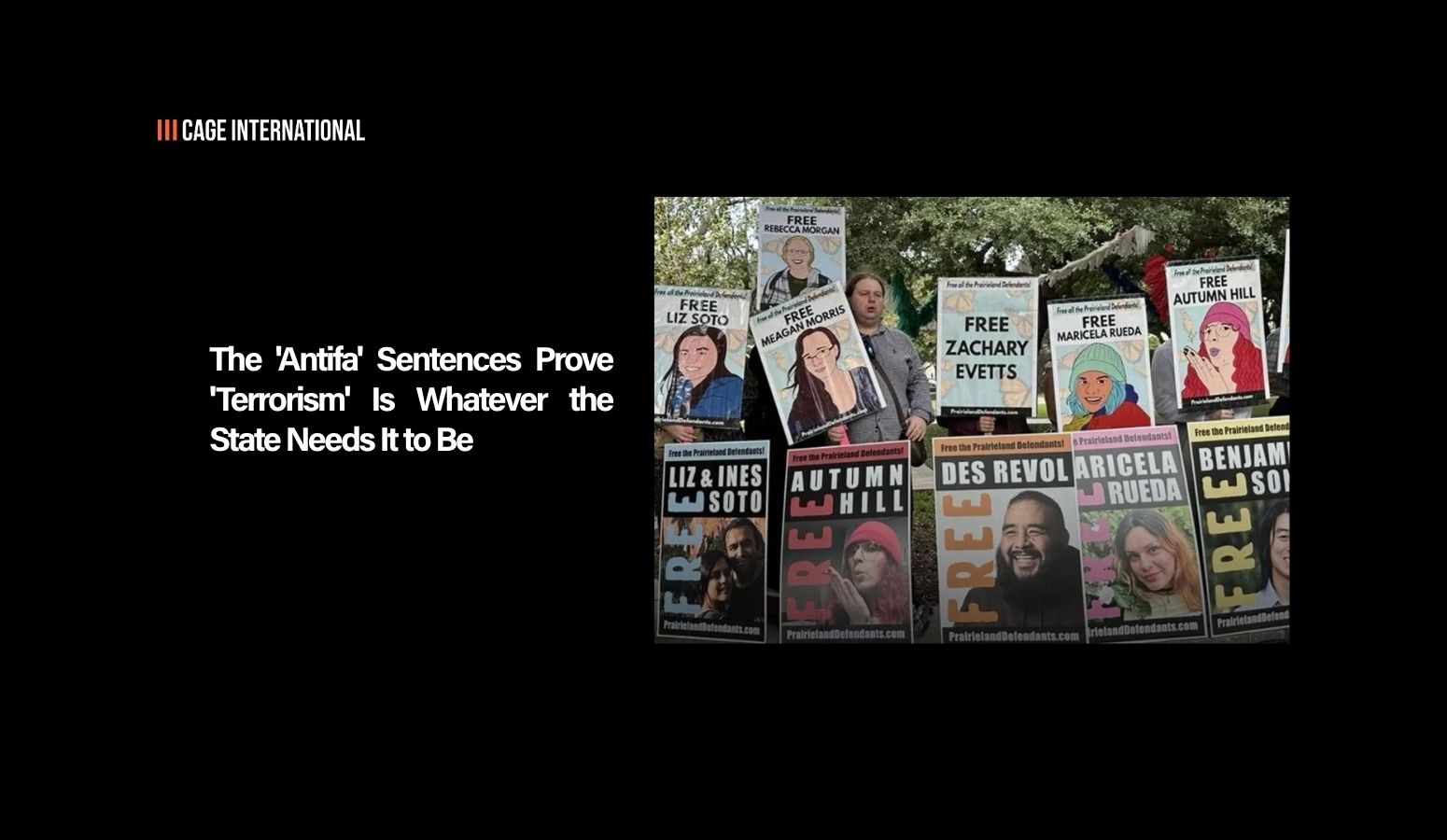

Dallas — Last month, in a Fort Worth courtroom, nine activists learned what it now costs to protest an ICE facility in Donald Trump's America. Their combined sentences run to roughly 450 years. One of them, Benjamin Song, was convicted of attempted murder and given 100 years. Another, Daniel Sanchez-Estrada, was not even at the protest. He was convicted of moving a box of zines after the fact, and sentenced to 30 years for it.
These are the sentences of a country that has decided that opposing racist state policies can be prosecuted as terrorism. The "Antifa cell" the Justice Department describes did not exist as a legal entity until Trump's executive order designated the group a domestic terrorist organisation in September 2025.
We at CAGE have spent two decades documenting exactly this pattern, just aimed at a different community. The same counter-terrorism architecture that jailed five Muslim charity workers in the same corner of Texas, as well as the same area that Dr. Aafia Siddiqui has been kept in conditions denounced by her lawyers, is now being turned on the left, a shift that grew directly out of the same War on Terror apparatus that produced ICE itself. This is what these laws were built to do: attach the word "terrorism" to whichever movement threatens the state's current priorities. This strategy traces back to a counter-terrorism plan crafted by Sebastian Gorka, a familiar figure in the Islamophobia industry, finally stripping away the illusion that terrorism powers were anything more than a tool to crush dissent.
The disparity with treatment of the 6th January insurrectionists makes the point better than we could. Rioters who stormed the US Capitol, assaulted police officers, and attempted to halt the certification of a presidential election received an average sentence of around two years. The Prairieland defendants, whose alleged violence amounted to one gunshot from one man during a protest outside a detention centre, received sentences that will keep most of them in prison for the rest of their natural lives. The difference is who the defendants were and if the administration favours them. The trial itself carried the same irregularities that attend most terrorism prosecutions: the judge refused to allow discovery (disclosure) on evidence that would have undermined the government's case, and an employee of an islamophobia peddling think tank, designated a hate group by the Southern Poverty Law Center, was permitted to testify in support of the state's theory, in an echo of the contested Israeli intelligence testimony that helped convict the Holy Land Foundation defendants.
The same mechanism is at work in Britain. Palestine Action, a group whose signature tactic is spraying red paint on Israeli weapon factories, was proscribed as a terrorist organisationlast July. A UK High Court judge found the ban unlawful in February, ruling that only a handful of the group's hundreds of actions met the legal definition of terrorism. The Court of Appeal overturned that ruling in June. The proscription stands. Because expressing support for a proscribed organisation is itself a terrorism offence in the UK, holding a placard reading "I oppose the ban on Palestine Action" has been enough to get people arrested - well over a thousand so far.
The method is to steadily expand the use of Terrorism powers as a tool of political repression. In Texas, that meant treating Signal messages and anarchist reading habits as evidence of criminal conspiracy, an approach we recognise instantly from prosecutions that once treated Arabic phrases as evidence of extremist intent, aided by a draconian sentencing enhancement . We documented this same enhancement in our own report, Guantanamo Begins at Home, which traced how the provision has already been used to multiply sentences for Muslims, years before it was ever pointed at any protest movement. In Britain, it meant exaggerating property damage against an arms company complicit in genocide into the same legal category deadly acts of political violence.
The lesson of Prairieland is not that America has suddenly discovered a new form of political repression, but that the infrastructure for this repression was built two decades ago, tested first on Muslim communities under a doctrine of national security exceptionalism rooted in Islamophobia and anti-Palestinian racism, and is now robust enough to be redirected at anyone the government of the day chooses to call a terrorist. Terrorism, as a legal category, exists to exceptionalise certain crimes - to justify disproportionate punishment and the bypassing of due process that would otherwise apply.
The response to Prairieland cannot be a better, narrower definition of terrorism. Terrorism powers were never designed as ordinary criminal law; they are exceptional, emergency powers, and exceptional powers are by nature political - built to be pointed at whoever the state needs to discriminate against, repress, or use as a pretext to grow its own reach. Every act at issue here: an assault, arson, a shooting - was already a crime, prosecutable under existing statutes with existing protections. Nothing about Prairieland required a terrorism charge except the desire to punish disproportionately and strip away due process along the way. That is not a case for reforming what counts as terrorism, but for, as we have consistently advocated - abolishing the entire apparatus.
Download Files


