


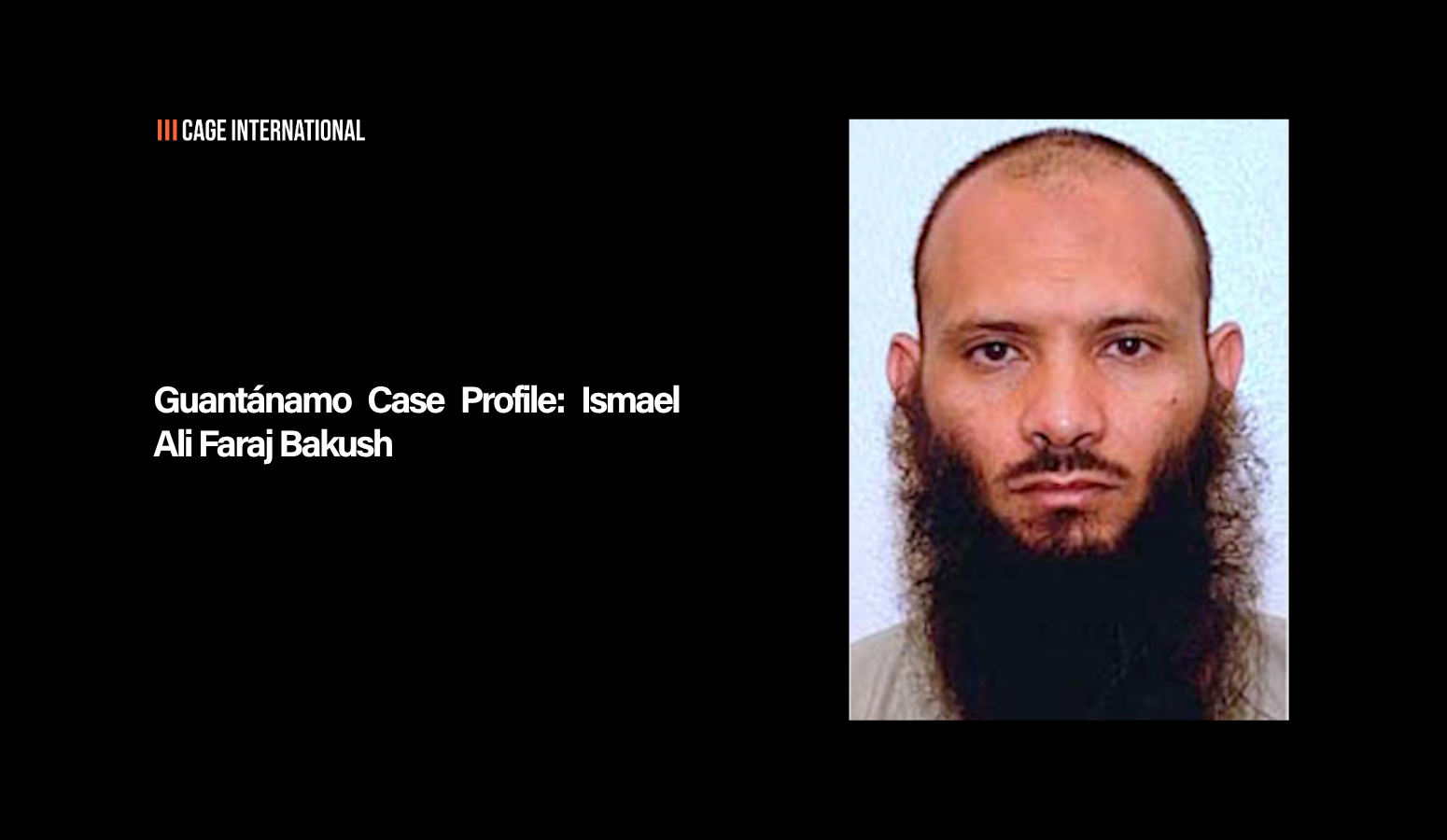
Guantánamo Case Profile: Ismael Ali Faraj Bakush

Summary
Ismael Ali Faraj Bakush was captured in Pakistan in 2002 and transferred to Guantánamo Bay, where he has been held ever since without charge or a fair trial. Now 57, he has spent over a third of his life imprisoned despite consistently maintaining his innocence.
Cleared for release by the U.S. government in 2022, Ismael remains trapped in detention due to political inertia and the instability of Libya, which cannot safely receive him.
His case makes it clear that continued detention is no longer about security, but about a failure of political will.
Background
Born in Khums, Libya in 1968, Ismael Ali Faraj Bakush trained as a mechanical engineer and lived a quiet life before the collapse of the Libyan state and the chaos of global jihad swept him into suspicion.
He dedicated his early life to community projects, repairing water pumps, training young people in trade skills, and helping his neighbors survive under difficult conditions.
Capture
Captured in early 2002 in Lahore, Pakistan, alongside other Libyan men, he was sent to Bagram, then Guantánamo, where he has remained ever since.
There are no credible allegations against Ismael and he has never been charged, nor given a fair hearing in a proper court. He has always maintained his innocence.
He is now 57 years old and has spent more than one-third of his life in Guantánamo.
In 2022, he was finally cleared for release - recognised by the U.S. government itself as posing no threat.
Yet Ismael still wakes up each day in a prison cell. He has watched his youth, his health, and his family slip away. He has been made to pay a price with no crime, no sentence, and no end.
His life has been buried under false assumptions, media silence, and international apathy.
Hopes for freedom
Ismael suffers from chronic pain and psychological scars. The injustice of watching others go home while he remains behind is unbearable.
He believed his fate was sealed, but in 2022, to his surprise, the Periodic Review Board cleared him—but four years later, he is still in a cage.
Ismael has been cited as saying: “I don’t need your forgiveness. I need my freedom.” I was cleared. I wait every day to hear my name. My friends have gone home. Why am I still here?”
He enjoys watching and playing sports such as soccer and swimming. Ismael also enjoys cooking for others and as a result, would like to work in the restaurant industry or run a store. He would also like to get married and have children of his own.
Call to Action:
Libya remains too unstable to receive returnees. But other countries can and must offer a safe haven. Ismael has been cleared for transfer. His continued detention is not about justice - it’s about political cowardice. End it now.
Download Files


