


Myanmar’s conviction for genocide should be the first of many
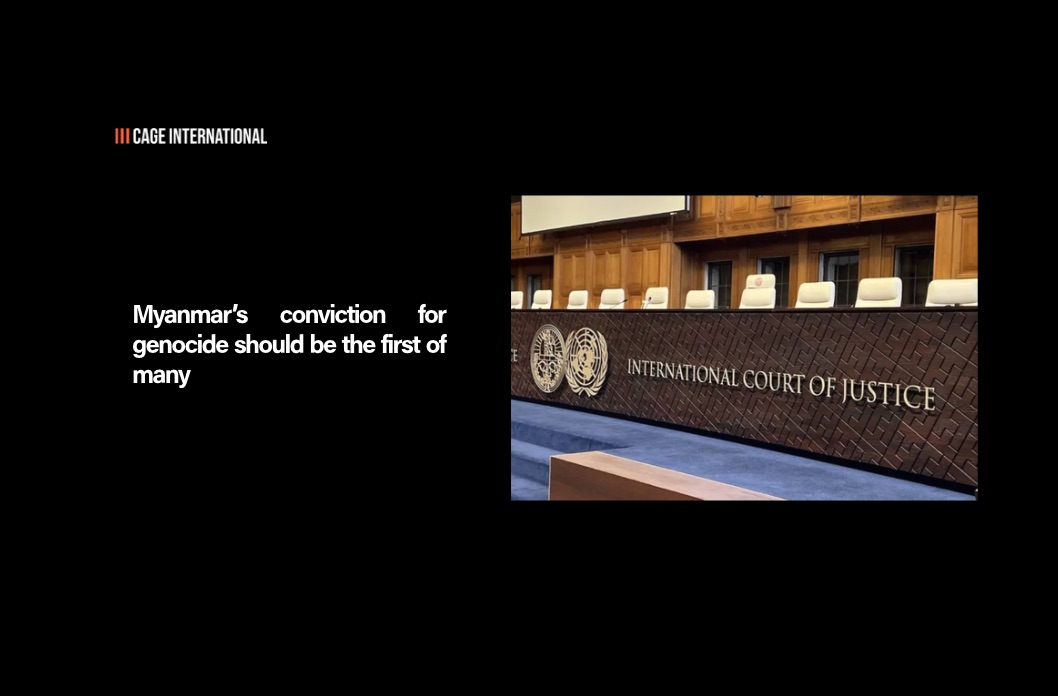

- On 19 November 2026, the International Court of Justice found by 9 votes to 6 that Myanmar committed genocide against the Rohingya in northern Rakhine State during the 2016-17 “clearance operations”
- This is the first time the world court has found a state responsible for committing genocide, not just for failing to prevent or punish it
- The court rejected Myanmar’s claim that the operations were counter-terrorism or counter-insurgency measures against the armed group ARSA
- It found Myanmar committed killings, caused serious bodily and mental harm, and imposed measures to prevent births, and that it failed to prevent and punish genocide
- Myanmar must report back within two years on restitution and compensation, and give assurances of non-repetition
- The case was brought in 2019 by The Gambia, on behalf of the Organisation of Islamic Cooperation
- More than 700,000 Rohingya were driven into Bangladesh in 2017, and most remain in camps there
London — Today the International Court of Justice found that Myanmar committed genocide against the Rohingya, bringing to a close a case that The Gambia first brought seven years ago.
The significance of the ruling extends well beyond Myanmar. At its centre lies a question that has defined the past quarter century: whether a state may destroy a people so long as it describes that brutality as counter-terrorism. Since 2001, the War on Terror has given governments across the world a vocabulary in which entire populations can be recast as security threats, and in which their dispossession, confinement and killing can be presented as self-defence. Myanmar did not invent that vocabulary, nor did it misuse it. It applied it exactly as it was designed to be applied. In that sense, what the court has examined today is not only one state’s crime but the logic that made it speakable.
The persecution of the Rohingya long predates the War on Terror. Over decades they were stripped of citizenship under the 1982 citizenship law and relabelled “Bengali” foreigners in the land where they had always lived. The state regulated whom they could marry and how many children they could have, confined them to segregated villages and camps, and taught the wider population to regard them as infiltrators and a demographic threat. The War on Terror supplied the final step. When the army moved into northern Rakhine in August 2017, following attacks by ARSA, it presented the campaign as counter-terrorism. Villages were burned, sexual violence was carried out on a mass scale, thousands were killed, and more than 700,000 people were driven across the border into Bangladesh. Myanmar maintained that account through every stage of the proceedings in The Hague.
It is also a principle that has so far been applied very selectively. The template Myanmar used was written in Washington and London, refined by Israel over decades of occupation, and adopted by Russia in Chechnya and by China in Xinjiang, the same two states that have shielded Myanmar at the Security Council. By Brown University’s estimate, the wars waged under the banner of the War on Terror have left at least 4.5 million people dead, and none of the governments responsible has been called before a court. Israel now advances in Gaza the same defence that Myanmar advanced in Rakhine, and its Western allies continue to arm and protect it. The United States, for its part, ratified the Genocide Convention only on condition that no case of this kind could be brought against it without its consent. The court has no means of enforcing its own judgments and depends on a Security Council where the powerful protect themselves and their allies. Under those conditions, whether a state is held to account depends less on what it has done than on who stands behind it.
Anas Mustapha, Head of Public Advocacy at CAGE, said:
“For twenty-five years the War on Terror has taught governments that almost any atrocity can be defended if it is called counter-terrorism. Today, for the first time, a court has refused to accept that defence, and Myanmar has been held to account for a genocide it carried out in that language. The governments that wrote the language, from the invasions of Afghanistan and Iraq to the genocide in Gaza, have so far escaped any such reckoning. We hope this judgment marks the beginning of a different era, one in which no state that commits genocide can rely on its allies to shield it, however powerful those allies are and however long they been subjecting the world to their brutality.”
Overview of the courtroom at the International Court of Justice (ICJ) in The Hague, Netherlands on 22 April, 2024 [Selman Aksünger/Anadolu Agency]
Download Files


