


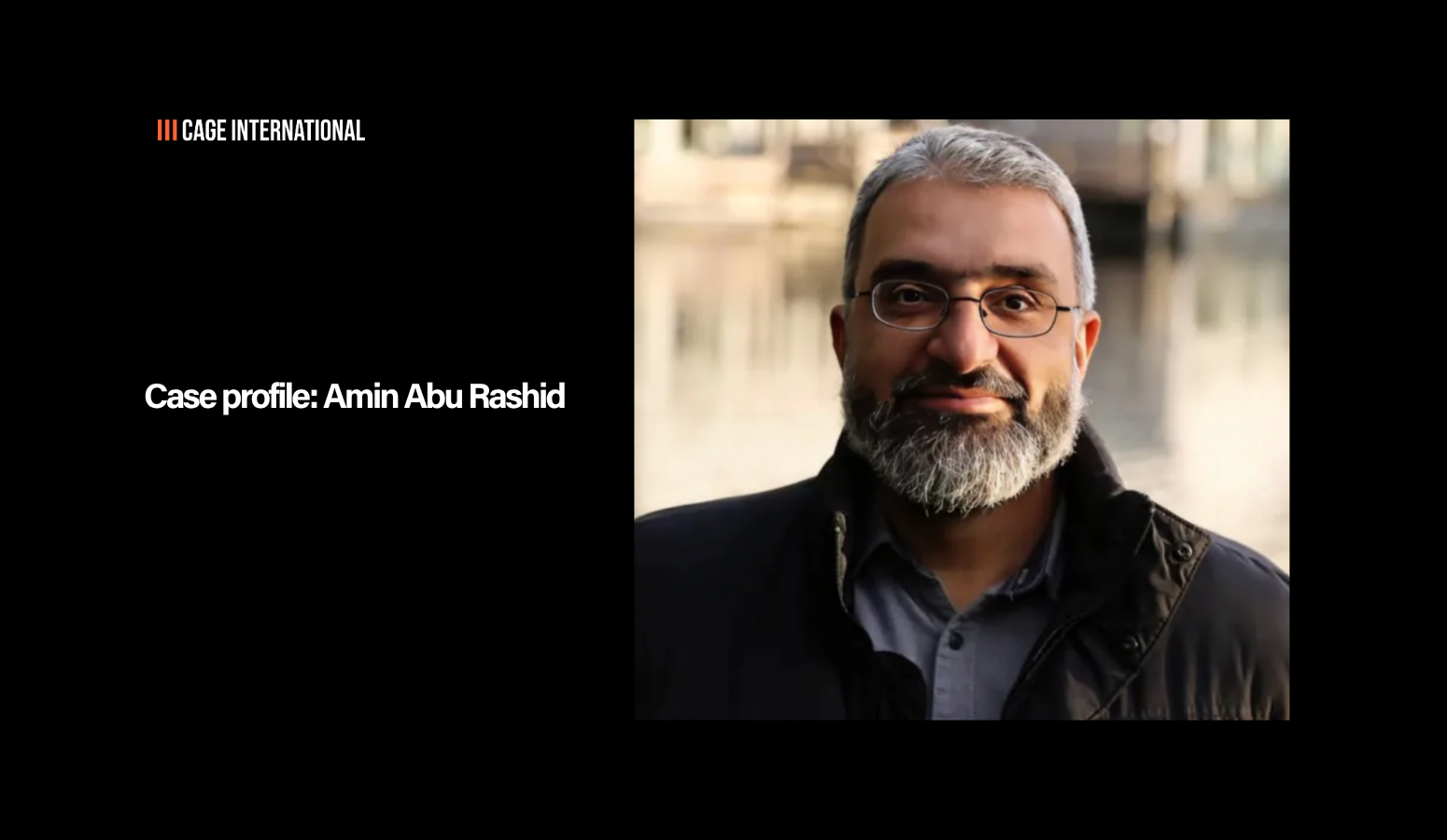
Case profile: Amin Abu Rashid

Summary
Amin Abu Rashid is a Palestinian-Dutch humanitarian organiser who has spent decades supporting Palestinian communities across the diaspora. In June 2023, he was arrested by Dutch authorities at the instigation of Israeli intelligence operatives, accused of breaching EU sanctions by sending funds to Gaza. He spent nearly a year on remand before being released on bail in May 2024. On 27 May 2026, Rotterdam District Court acquitted him of the principal charges, ruling that the prosecution's evidence, drawn largely from Israeli government sources, was unreliable and insufficient to prove any wrongdoing.
Who is Amin Abu Rashid?
Amin Abu Rashid was born in 1967 in a Palestinian refugee camp in Beirut, Lebanon - the same year as one of the Nakba’s that punctuated the ongoing dispossession of his people. He grew up in the camp with the understanding, shared across generations, that displacement was temporary. "The camp is a temporary station," he recalls. "Always heading the way back to Palestine."
From around the age of eight he attended scout groups where he learnt the history, heritage and dignity of the Palestinian people. Palestine was not an abstraction but a living inheritance: something to be known, carried, and returned to.
In 1982, Israeli forces swept through Lebanon. Until then, the occupation and its violence had been something witnessed at a distance, on television screens. Now it was immediately in his presence. The Palestinian communities of Beirut bore the full force of the assault. Abu Rashid's wife was among the few children to survive the Sabra and Shatila massacre, rescued by Italian forces.
In 1986, at the age of 19, Abu Rashid was himself struck during an Israeli attack. He lost his left eye, his right arm, and his foot, and sustained injuries requiring over 400 stitches. He was taken to Cyprus and then to Yugoslavia for treatment. When he returned to Lebanon, civil war had broken out. He went back to Yugoslavia, and when war consumed that country too in 1992, the UN arranged his resettlement in the Netherlands as a refugee. He has lived there as a Dutch national ever since, with his wife and two daughters.
"After arriving in Holland, I wanted to do something for my people."
A life in service
Abu Rashid became a central figure in Palestinian community and humanitarian life in the Netherlands. He served as head of the Dutch branch of the Al-Aqsa Foundation until its closure in 2003, and later established the Israa Foundation, through which he continued raising and distributing aid to Palestinians in Gaza, the West Bank, and the refugee camps of Lebanon - reaching orphans, widows, and displaced families whose names never appear in official reports.
All funds were transferred through documented banking channels, routed via the Palestinian Authority using the same mechanisms as UNRWA and other major international agencies.
In October 2008, he organised the first humanitarian flotilla from Cyprus to Gaza - the ship was named Hope. It was the first time Abu Rashid had set foot on Palestinian land. He was accompanied by Mustafa Barghouti and others who refused to accept the siege as permanent.
In 2010 and 2011, he was involved in organising the Freedom Flotilla, with the Mavi Marmara among the vessels. He was arrested in Bier Asabaa’ and held as one of the last activists to be released, before being returned to the Netherlands. He understood at the time that Israel did not regard him as a serious threat, but that assessment would change.
In 2021, he was elected leader of the European Palestinian Conference. In 2023, he organised and chaired the Conference in Malmo - attended by 20,000 Palestinians and solidarity activists from across the continent. The Israeli government deployed its ambassadors in Sweden and the Netherlands in an attempt to prevent the conference from taking place. It went ahead on 27 May 2023.
Arrest and imprisonment
Israel had classified Abu Rashid as a terrorist as far back as 2010, placing him tenth on its wanted list. By 8 June 2023, days after the Malmo conference, he had been elevated to number one. He notes, with characteristic composure, that he found himself more wanted than Yahya Sinwar.
Three days later, on 11 June, Dutch authorities froze his bank accounts and those of his daughter. On 22 June 2023, he was arrested at his home.
The arrest was the culmination of a years-long campaign coordinated between the Israeli government, its ambassador to the Netherlands, and the Israeli intelligence-linked NGO Ad Kan, which had run a multi-year undercover operation infiltrating Palestinian solidarity networks. The charges alleged that Abu Rashid had breached EU sanctions by sending approximately €11.7 million to Gaza.
He was remanded to Sittard prison, a four-hour drive from his family home near Rotterdam. His daughter was also detained and held for two months. While in prison, Abu Rashid received the news that the woman who had raised him had died, and he was not free to grieve.
The conditions in Sittard were severe. He was confined to his cell for all but thirty minutes each day. In the Netherlands, prisoners pay for their own upkeep, but with his accounts frozen and all access to funds cut off, he had no means to do so. When a relative attempted to send money, they were threatened with account closure. He relied on a single publicly funded meal per day.
His wife's first visit was permitted after a month, which was an eight-hour round trip. He was not transferred to a facility closer to home or better suited to his medical needs until October 2023. He had suffered cerebral hypertension, a complication of the hundreds of internal stitches carried since his injuries in 1986, with blood pressure reaching 210 mmHg systolic. He did not see a doctor until April 2024. When he did, the physician's report asked the court to release him so that he could, in the court's words, "die at home."
He was released on bail on 16 May 2024, after nearly a year on remand.
His trial and verdict
On 27 May 2026, which coincided with Eid al-Adha, and the third anniversary of the Malmo conference, Rotterdam District Court acquitted Amin Abu Rashid of the principal charges against him.
The court found that the prosecution's evidence was inadequate to establish that the funds he transferred had reached Hamas. Its key expert witness, a "Middle East specialist" based in the United States who relied almost entirely on Israeli government reports and press articles, was found to lack credibility. The court stated plainly: "Those reports are from Israel and the US in a situation where Israel and Hamas are killing each other. So that's a problem. So you have to be very careful with those reports... We are not going to condemn people for what is stated in the newspaper."
On a subsidiary matter, his continuation of charitable work connected to the Al-Aqsa Foundation after its sanctioning, between 2003 and 2011, the court found him responsible but imposed only a six-month suspended sentence, noting that the events were so long ago that a custodial sentence was no longer appropriate. He had already served nearly a year in pretrial detention.
Abu Rashid walked free.
"My case is not personal," he has said. "It is the battle between Palestinian rights and the Zionist lobby. If we win, justice is done. If we do not, we have always known that the way home is a long path, and we will continue to tread it."
Download Files


